Frase Alternative: Best AI SEO Content Tool for Teams
If you're shopping for a Frase alternative, you're usually not unhappy with Frase itself — you're bumping into the shape of it. It optimizes one document at a time, in its own editor, for one writer. That works until a small team needs to research, draft, edit, and approve ten articles a month without the whole thing living in one person's head.
Here's the short version: Frase is a solid content optimization editor. The gap most teams hit isn't optimization quality — it's the workflow around it. This article gives Frase a fair look, names where it falls short for a small team, and shows how a multi-stage automated workflow handles the same job differently.
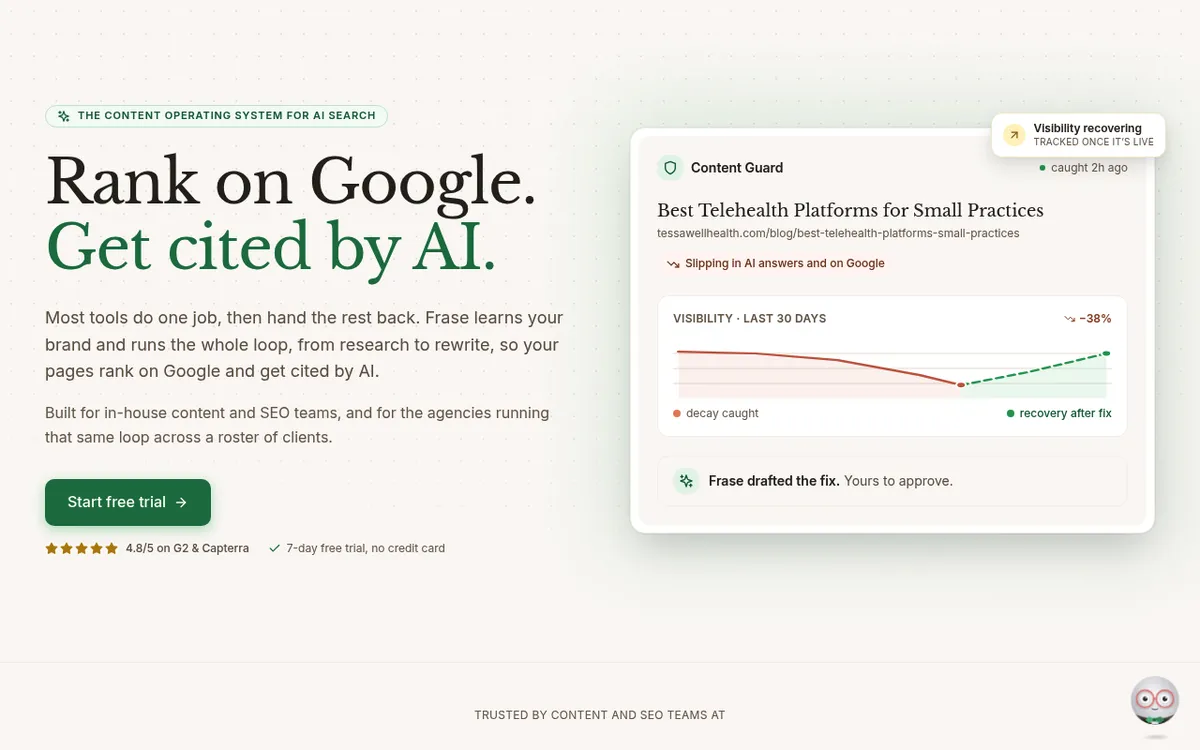
Why teams look for a Frase alternative
Frase earns its place. But a few recurring frictions push teams to compare options, and most of them are about scale and workflow, not features.
- AI word caps. Frase's plans meter AI-generated words. If you're publishing weekly, you can hit the ceiling mid-month and end up buying add-ons or rationing drafts.
- NLP scoring that trails dedicated optimizers. Frase's term-scoring is good, but roundups consistently rate it a notch below Surfer and Clearscope on optimization depth. If pure scoring is your priority, that matters.
- A single-editor workflow. Frase optimizes a document you still write, manage, and route for review yourself. There's no built-in handoff between a researcher, a writer, and an editor.
None of these makes Frase a bad tool. They just show up more the moment content becomes a team sport instead of a solo task. If you're weighing several tools at once, our roundups of the best content marketing tools and best AI writing tools are a good companion read.
What Frase does well
Being fair here isn't politeness — it's how you make a good decision. Frase is genuinely strong in a few areas, and if these are what you need, you may not need an alternative at all.
- SERP-based content briefs. Frase pulls the top-ranking pages for your keyword and builds a brief from what's actually ranking. It's fast and grounded in real results.
- Question research. Its People Also Ask mining is one of the better ways to find the questions your audience is asking, which feeds directly into headings and FAQ sections.
- A clean outline builder. Turning a SERP analysis into a working outline takes minutes, not an afternoon.
- An affordable entry point. Compared to Clearscope's pricing, Frase is accessible for solo writers and small budgets.
You can read more on Frase's own feature pages to see the current lineup. If your job is "optimize this one article against the SERP," Frase does that well and does it cheaply.
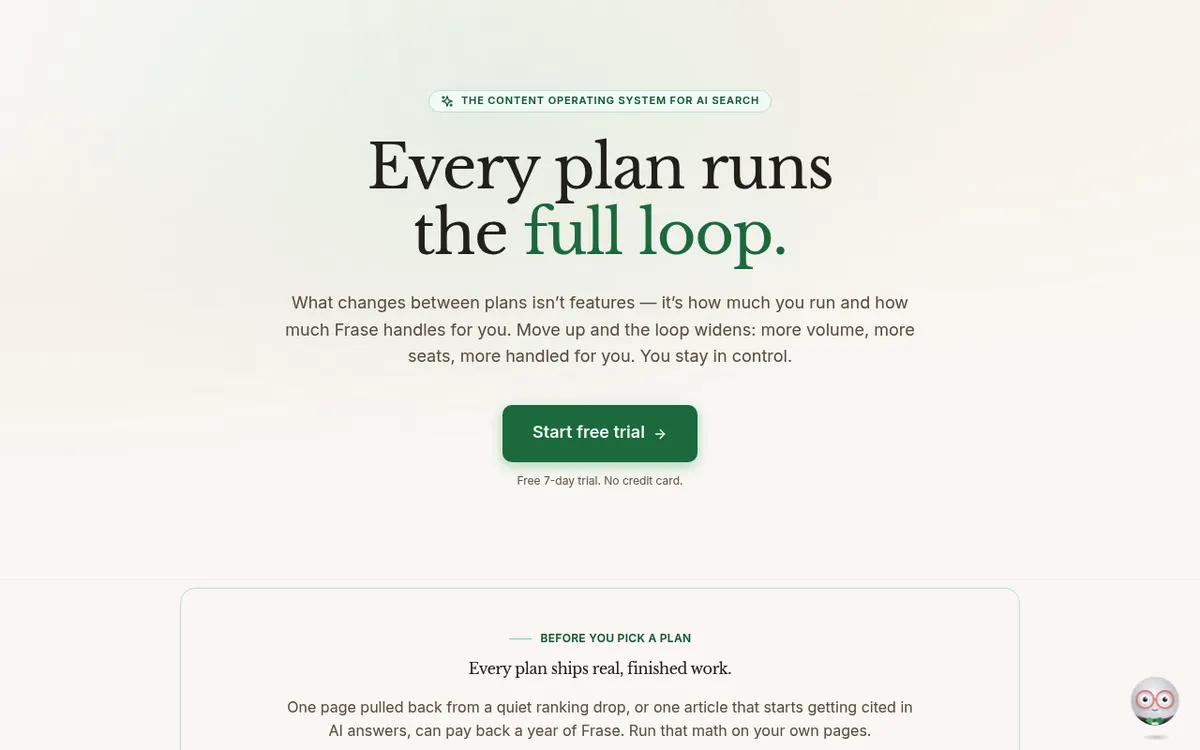
Where Frase leaves gaps for small teams
The gaps aren't in what Frase does — they're in what it leaves for you to do. An optimization editor assumes a human is driving every step. For a small marketing team, that assumption is the bottleneck.
You still write and manage everything. Frase scores and suggests, but the draft, the edits, and the routing are yours. Multiply that across a content calendar and the tool saves you optimization time while leaving the coordination cost untouched.
There's no built-in editorial layer. Research, drafting, and review live in your process, not the tool's. On a small team, "who's editing this and did it get approved?" is exactly the question that slows things down.
It lives in its own editor. Your drafts sit in Frase, your calendar sits somewhere else, and your approvals happen over Slack or comments. That's another window, another copy-paste, another place for a draft to get lost. Building a repeatable content marketing workflow around a standalone editor is doable, but it's work you're doing, not work the tool is doing.
Optimization is only one stage. A published article is the end of a chain: pick the keyword, research the SERP, write, edit, approve, publish, then track how it ranks. Frase sharpens the writing stage. The stages on either side — keyword research and rank tracking — still live in separate tools, which is fine for a solo writer but adds up fast for a team juggling a calendar. If you want the full picture of that chain, our guide on how to do keyword research covers the front end.
This is the difference between an ai content optimization tool and a content system. Frase is the former. Teams shopping for a frase alternative for seo content are often really shopping for the latter.
How Lunroo approaches the same problem differently
Lunroo isn't another single-writer optimization editor. It runs the whole content workflow end to end on autopilot, with a human approval gate before anything publishes.
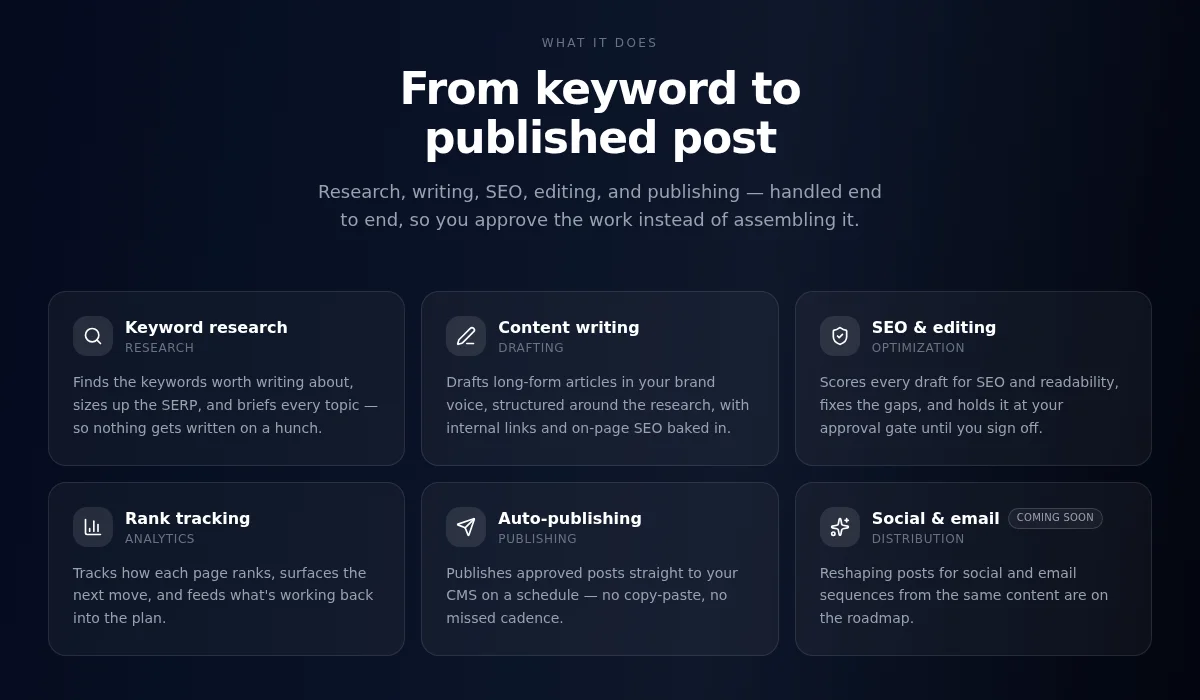
Here's how the stages split:
- Research — keyword data, SERP analysis, and the questions worth answering.
- Drafting — a draft in your brand voice, structured around that research.
- Editing — tightening, fact-checking prompts, and consistency.
- Publishing — the approved piece goes live, and the pipeline keeps moving so work doesn't stall between steps.
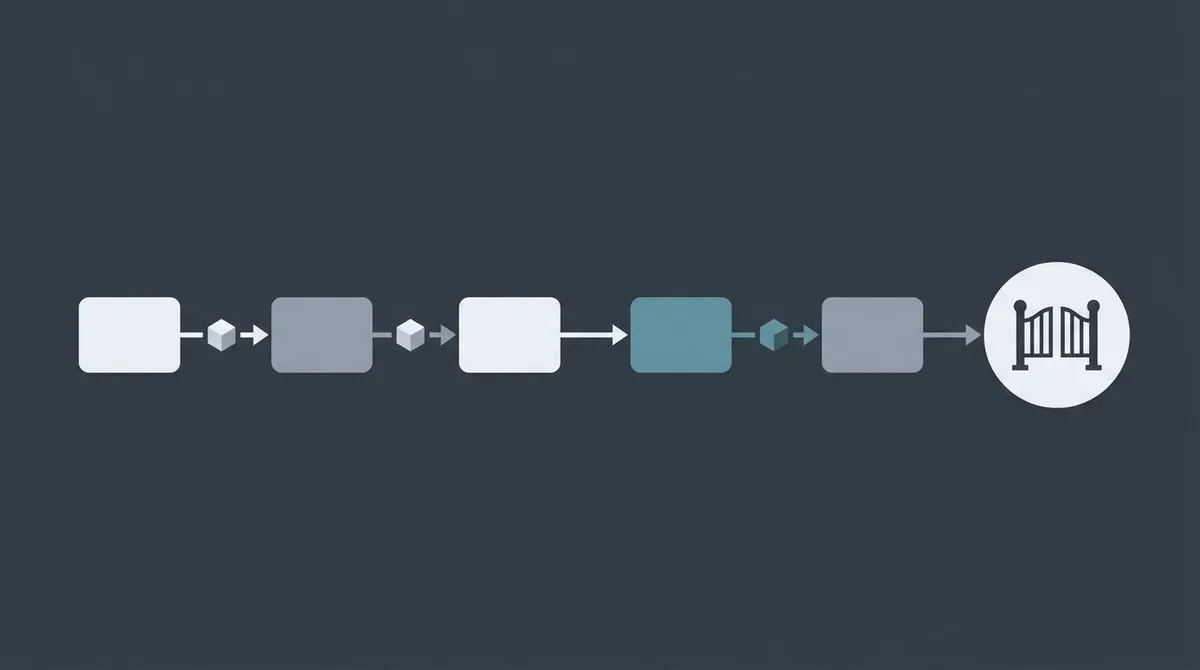
The key word is end to end. Instead of you carrying a document from research to draft to edit, each stage hands off to the next, and you step in at the approval point. Nothing ships without your sign-off — draft mode is the default, not an afterthought. If you want the deeper mechanics, how AI agents automate marketing walks through the orchestration in detail, and what are AI marketing agents covers the category.
It's also Notion-native. Briefs, drafts, and approvals live in your Notion workspace — where most small teams already plan — instead of in a separate editor you have to check. Rank tracking and analytics are part of the platform too, so the loop from "publish" to "did it work" stays in one place.
Two honest notes: social scheduling and email campaigns are on the roadmap, not live yet. And there's no free tier — Lunroo is a paid product. More on that below.
Frase vs Lunroo: comparison table
Different tools, different jobs. This table is honest about both — Frase is a strong optimizer, Lunroo is a workflow.
| Lunroo | Frase | |
|---|---|---|
| Primary model | Multi-stage automated workflow (research → draft → edit) | Single content optimization editor |
| Human approval | Draft-mode approval gate before publish | Manual editing; you route review yourself |
| Where content lives | Notion-native (plan and approve in Notion) | Frase's own editor |
| Workflow scope | Research-to-draft pipeline | Optimize a document you write |
| Editorial layer | Built-in editing stage before approval | Not built in; your process |
| Rank tracking & analytics | Included in the platform | Not the focus; optimization-first |
| AI output limits | Token budget included; not per-word metered the same way | AI words metered by plan |
| Best-fit user | Small team wanting an approve-before-publish system | Solo writer optimizing individual articles |
The row that matters most is the first one. Frase makes your writing better. Lunroo does more of the writing and routing for you, then waits for your yes. Neither is universally "better" — they solve adjacent problems.
If you're comparing across the whole category, it's worth reading our SurferSEO alternative and Jasper alternative breakdowns too, since Surfer, Clearscope, Scalenut, and Jasper come up in nearly every Frase comparison.
Which tool is right for your team
Let's break this down by who you are.
Choose Frase if: you're a solo writer or a lean setup, you mainly need to optimize individual articles against the SERP, and you want a lightweight, affordable standalone editor. Frase's briefs and PAA research are genuinely good, and if optimization is the whole job, adding a full platform is overkill.
Choose Lunroo if: you're a small marketing team with a real backlog, you want research-to-draft handled as a pipeline rather than one document at a time, and you need an approval step so nothing publishes without a human saying yes. The Notion-native part matters most here — if your team already plans in Notion, keeping drafts and approvals there removes a whole layer of copy-paste.
A quick gut check: if the phrase "who's writing this week and did it get reviewed?" is a recurring headache, that's a workflow problem, and an optimization editor won't fix it. If your only friction is "this article could rank better," Frase is a fine, focused answer.
Want to see the whole pipeline draft your next article end to end? Start with Lunroo — you'll watch research, drafting, and editing run the loop before you approve anything. For a broader look at putting your pipeline on autopilot, how AI agents automate marketing is the place to go, and content automation covers the fundamentals.
FAQ
Is there a free Frase alternative?
Frase and several optimization tools offer limited free tiers or trials, so if "free" is the hard requirement, those are your starting point. Lunroo doesn't have a free tier — it's a paid product with the full content workflow and tool credits included. If you want the current numbers, see pricing for the source of truth rather than a figure that ages badly.
Does Lunroo replace Frase?
For most teams, yes — Lunroo covers the research and drafting that Frase supports, then adds the editing, approval, and coordination Frase leaves to you. That said, if you specifically love Frase's SERP-based optimization scoring and only want that one job done, Frase is a focused fit. Lunroo is the better call when the workflow itself is the problem.
Is Lunroo good for small marketing teams?
That's exactly who it's built for. Running the whole content pipeline on autopilot gives a small team the output of a bigger one without the headcount, and the draft-mode approval gate keeps brand voice and accuracy under human control. You get leverage without giving up the sign-off step.
Does Lunroo work with Notion?
Yes — Lunroo is Notion-native. Briefs, drafts, and approvals live in your Notion workspace, so the whole team works where they already plan instead of in a separate editor. If your content calendar already lives in Notion, this is the part that saves the most day-to-day friction.
How much does Lunroo cost?
Lunroo is one paid plan, month-to-month, cancel anytime, with the end-to-end content workflow, tool credits, LLM tokens, brand voice, and analytics included. Prices change, so check pricing for the current figure rather than trusting a number in a blog post.
How is Lunroo different from an AI writing tool like Jasper or Copy.ai?
Tools like Jasper and Copy.ai are prompt boxes you drive manually — you're the operator. Lunroo is an automated pipeline whose stages hand off to each other and only pause for your approval. If you want the detailed contrast, our Jasper alternative and Copy.ai alternative pages break it down, and the best AI tools for marketing roundup puts the whole landscape in one view.