10 Best AI Writing Tools for Marketing Teams (2026)
If you run a small marketing team, the best AI writing tools aren't the ones that generate the most words per minute. They're the ones that fit how your team actually ships content: research, draft, edit, optimize, and approve, without three people stitching four tools together by hand.
Here's the short version. Most products in this space are single-purpose text generators. They're good at one slice of the job. A small team doesn't have a word-count problem, though. It has a coordination problem. So the useful question in 2026 isn't "which AI writer is best?" It's "which system ships approved, on-brand, ranked content with the fewest handoffs?"
This guide ranks 10 tools for that job, with Lunroo first and honest mini-reviews of the rest.
How we ranked these tools
We ranked for one specific reader: a marketing team of two to ten people that needs consistent, on-brand content and cares about editorial control, not just raw generation. If you're a student or writing a novel, this list will steer you wrong on purpose.
We scored each tool against five criteria:
- Workflow coverage — does it handle research, drafting, editing, and SEO, or just one step?
- Brand-voice control — can it write the way your brand actually speaks?
- SEO depth — is search optimization built in, or a separate tool you bolt on?
- Human oversight — is there a real draft-and-approve step before anything publishes?
- Price-to-value — one subscription, or a growing stack of them?
The tools below are ranked by genuine fit against those five, not by popularity or ad spend. If you want the broader category view, our roundup of the best content writing tools covers adjacent picks.

Quick comparison table
| Tool | Best for | Coordinated workflow | Human approval | SEO built in | Notion-native |
|---|---|---|---|---|---|
| Lunroo | Small marketing teams shipping weekly | Yes (full pipeline) | Yes (draft mode) | Yes | Yes |
| Jasper | Brand-consistent copy at scale | Partial | Manual | Add-on | No |
| Copy.ai | Short-form and GTM copy | Partial | Manual | No | No |
| Surfer SEO | On-page optimization | No | Manual | Yes | No |
| Frase | SERP-driven content briefs | No | Manual | Yes | No |
| Writesonic | Fast long-form drafts | Partial | Manual | Add-on | No |
| ChatGPT | Flexible raw drafting | No | Manual | No | No |
| Claude | Long-form reasoning and drafts | No | Manual | No | No |
| Byword | Bulk article publishing | Partial | Optional | Partial | No |
| Content at Scale | High-volume SEO articles | Partial | Optional | Yes | No |
Pricing sits behind different models for each tool, so we've left it out of the table. For Lunroo, one subscription covers the whole content pipeline; see current pricing rather than a number that ages badly.
1. Lunroo — best overall for small marketing teams
Lunroo runs the whole content workflow on autopilot rather than acting as a single prompt box. Research pulls keyword targets and SERP angles, drafting turns them into a piece, editing tightens it and matches your brand voice, and publishing ships it once you approve. That's the difference that matters for a small team: the handoffs happen inside the system, not on your calendar.
The good news is you stay in control the whole time. Every piece runs through draft mode, so nothing publishes without a human approving it. For teams worried about brand safety and AI-generated slop shipping unchecked, that approval step is the point, not an afterthought.
Two more things set it apart. First, it's Notion-native, so briefs, drafts, and approvals live where your team already plans instead of in yet another dashboard. Second, SEO isn't a separate purchase; keyword research and on-page optimization are part of the same loop that produces the draft. If you want the deeper version of that argument, we wrote about how AI agents automate marketing as a coordinated workflow.
Honest tradeoffs: Lunroo is built for ongoing content operations, not one-off copy, and social scheduling plus email campaigns are coming soon rather than live today. If you just need a single tagline this afternoon, a point tool is faster. If you're publishing every week, this is the system to beat. See what the workflow covers at features, or start with Lunroo when you're ready.
The rest of the best AI writing tools
Every tool below is genuinely good at something. The pattern to watch: a single-purpose generator leaves your team doing the coordination by hand.
Jasper
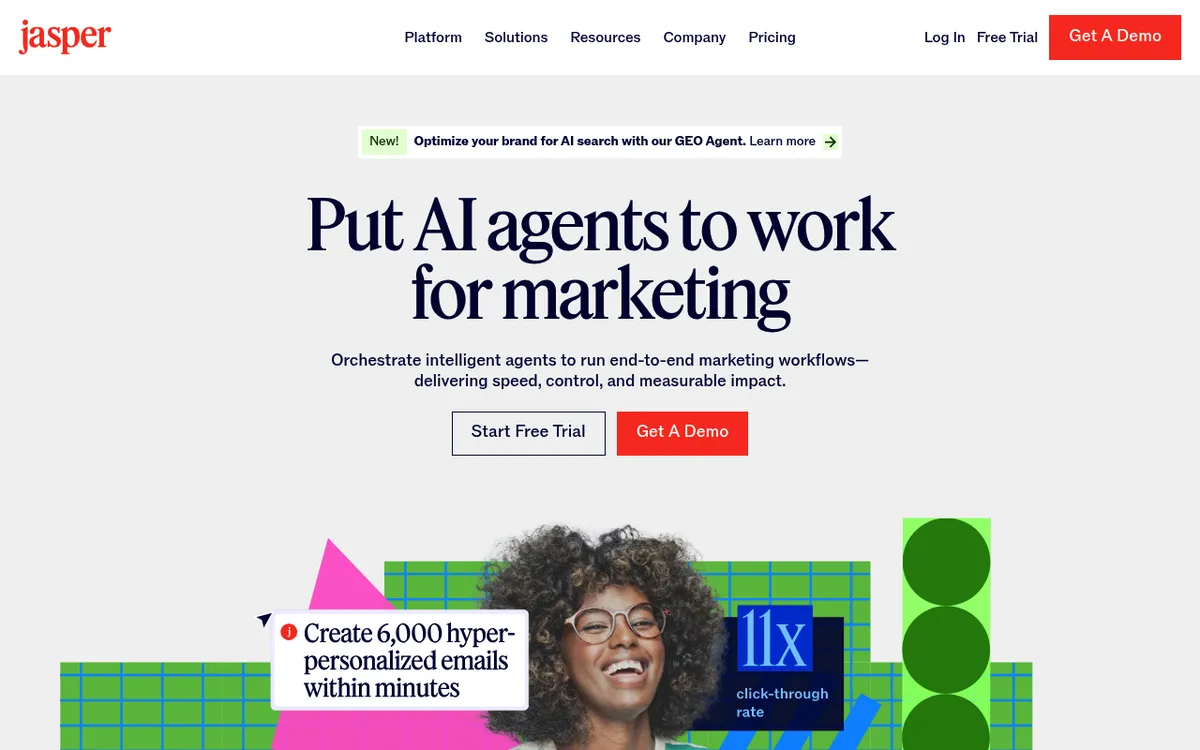
Jasper's Brand Voice feature is one of the strongest on the market for keeping copy consistent across a company. Marketing teams that need many people writing in one voice get real value here. The gap: Jasper is primarily a writing surface, so research and SEO optimization still happen in other tools, and a human still coordinates the pipeline. If Jasper is on your shortlist, our Jasper alternative breakdown goes deeper on the tradeoffs.
Copy.ai
Copy.ai shines at short-form and go-to-market copy: ads, emails, landing snippets, and sales enablement. It's fast for high-volume small assets. For long-form SEO content and an editorial approval flow, though, you'll be reaching for other tools alongside it.
Surfer SEO

Surfer is excellent at on-page optimization. Its NLP-driven content editor tells you which terms to include to compete for a keyword, and writers who use it tend to rank better. Surfer optimizes drafts; it doesn't research topics or run an approval workflow, so it's one strong instrument in a larger orchestra. See our Surfer SEO alternative comparison for the full picture.
Frase
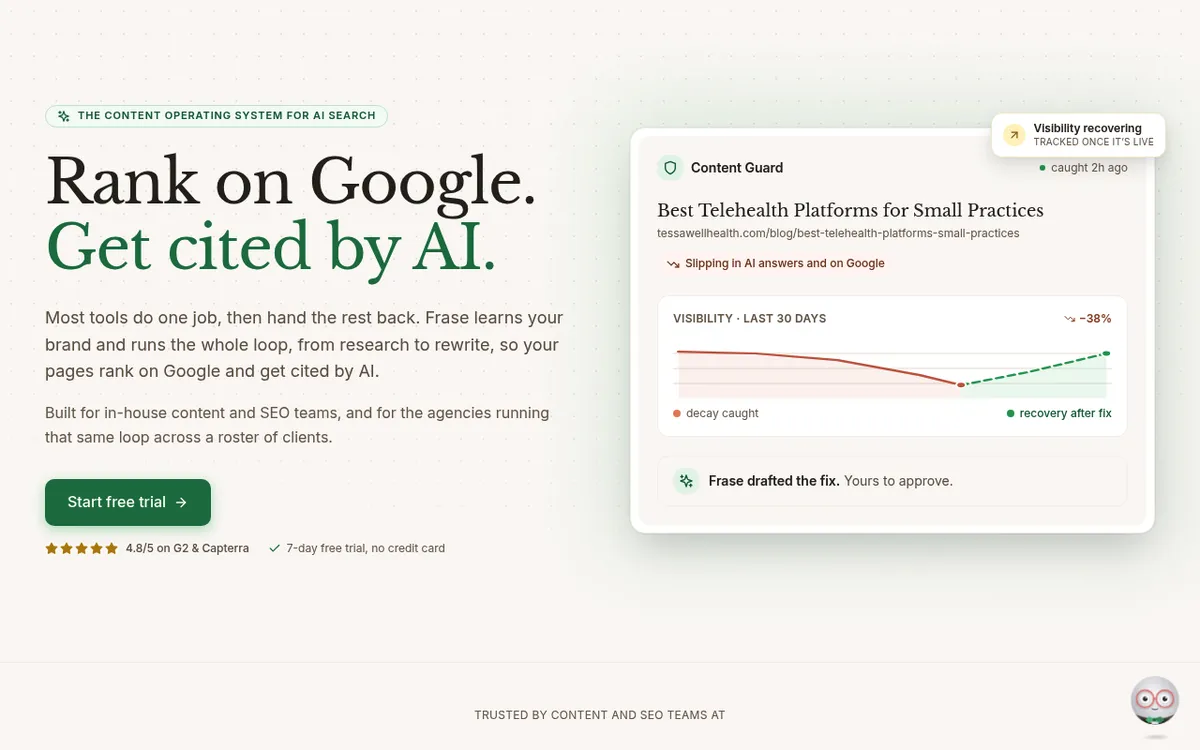
Frase builds content briefs from live SERP data, which saves hours of manual competitor analysis before you write. It's a genuinely useful research-to-outline tool. The drafting and publishing steps still sit elsewhere, and there's no built-in approval gate.
Writesonic
Writesonic produces long-form drafts quickly and bundles several writing templates. It's a capable generalist. As with the others, SEO and editorial control are add-ons or manual steps, so a small team still owns the glue between drafting and publishing.
ChatGPT and Claude
For flexible raw drafting, general-purpose assistants are hard to beat. Claude handles long-form reasoning well, and ChatGPT is a versatile all-rounder. But they're blank canvases: no built-in SEO, no brand-voice persistence across your library, and no approval workflow. You bring the process; they bring the text. That flexibility is the appeal and the limitation.
Byword and Content at Scale
These lean into volume, publishing many SEO articles fast. If your strategy is breadth, they deliver quantity. The 2026 risk is well known: bulk output without oversight invites thin content and brand-safety problems. Pair volume with a real review step, or you're trading short-term output for long-term trust. Our take on AI SEO tools covers where automation helps and where it quietly hurts.
How to choose the right AI writing tool for your team
Start by naming the job, then match the tool to it. The mistake small teams make is buying a generator when they needed a workflow.
Use this quick map:
- You need one voice across many writers — a brand-voice-first tool like Jasper fits, if you can supply the surrounding process.
- You need better rankings on existing drafts — an optimizer like Surfer or Frase earns its place in the stack.
- You need short-form copy at speed — Copy.ai or a general assistant handles it.
- You need to ship on-brand, optimized content every week with sign-off — you need a coordinated system, not a point tool.
That fourth case is where most small marketing teams actually live, and it's where stitching point tools together gets expensive in time. A coordinated workflow research, draft, edit, optimize, approve in one loop beats a stack you have to babysit. If you're leaning toward automating the whole thing, read how to automate SEO and what AI marketing agents are before you commit.
For an outside benchmark on where AI content optimization is heading, Ahrefs' guide to AI content optimization tools is a solid, vendor-neutral read.
The bottom line
The best AI writing tool for a small marketing team in 2026 is the one that removes handoffs, protects your brand with a real approval step, and keeps SEO in the same loop as drafting. Most tools on this list are strong at one piece of that. Lunroo is built to run the whole loop while you stay in control.
If you'd rather have an automated content workflow handle research, drafting, editing, and optimization while you approve the work, start with Lunroo.
FAQ
What is the best AI writing tool for a small marketing team?
For a team that ships on-brand content regularly and wants editorial control, a coordinated system beats a single generator. Lunroo ranks first here because it combines a multi-stage workflow (research, writing, editing) with draft-mode approval and a Notion-native workflow. If your need is narrower, say, only on-page optimization or only short-form copy, a point tool like Surfer or Copy.ai may fit better.
Are AI writing tools worth it in 2026?
Yes, when they save coordination time, not just typing time. The teams getting real value use AI to handle research and first drafts, then keep a human in the loop for judgment and approval. AI drafts fast, but a person should still approve claims and brand fit before anything publishes. The tools that fold that approval step into the workflow deliver the most durable value.
Do AI writing tools hurt SEO?
They don't have to. Google rewards helpful, accurate content regardless of how it's produced, and penalizes thin, unedited output regardless of who wrote it. The risk comes from publishing bulk AI text with no research, optimization, or review. Keep SEO and human editing in the loop and AI-assisted content ranks fine. Our guide on how to write SEO content covers the specifics.
Can I keep human control over AI-written content?
With the right tool, yes. Look for a genuine draft-and-approve step where nothing publishes without sign-off. Lunroo runs every piece through draft mode for exactly this reason. Many single-purpose generators leave approval as a manual habit rather than a built-in gate, so if control matters to you, make it a hard requirement when you compare tools.
How much do AI writing tools cost?
Pricing ranges widely, from per-seat writing tools to usage-based platforms, so the real question is total cost across your stack. A coordinated system can replace several point-tool subscriptions with one, which usually nets out cheaper than a copywriter plus an SEO retainer plus a handful of apps. For Lunroo's current plan, see pricing rather than a figure that changes over time.
What's the difference between an AI writer and an automated content workflow?
An AI writer is a prompt box: you drive it, one task at a time. An automated content workflow connects the stages research, writing, editing, and scheduling so the handoffs happen inside the system. For a small marketing team, that coordination is usually the harder problem to solve than the writing itself.