How to Optimize Content for LLMs: A Citation-First Guide
Learning how to optimize content for LLMs comes down to one shift. Write passages that still make sense after software lifts them out of your page. ChatGPT and Perplexity do not read your post in order. They pull short blocks of text, score them, and quote the ones that answer a question on their own.

This guide starts with the steps that pick winners. Then it shows a full rewrite of one weak section, marked up so you can see which edits count. It assumes you already handle the basics of SEO writing.
People call this work LLM SEO, ChatGPT SEO, or GEO. The labels differ. The tactics below stay the same either way.
Why LLMs Quote Passages and Not Pages
Most advice on this topic skips the plumbing. That is a shame. The plumbing tells you exactly what to fix.
When an AI tool answers a question, three things happen to your page:
- Chunking. Your page is cut into small blocks. A block is often one or two paragraphs.
- Embedding. Each block becomes a list of numbers that stands for its meaning. The question becomes one too.
- Re-ranking. Close blocks get pulled, then a second model scores them again. Only the top few reach the answer.
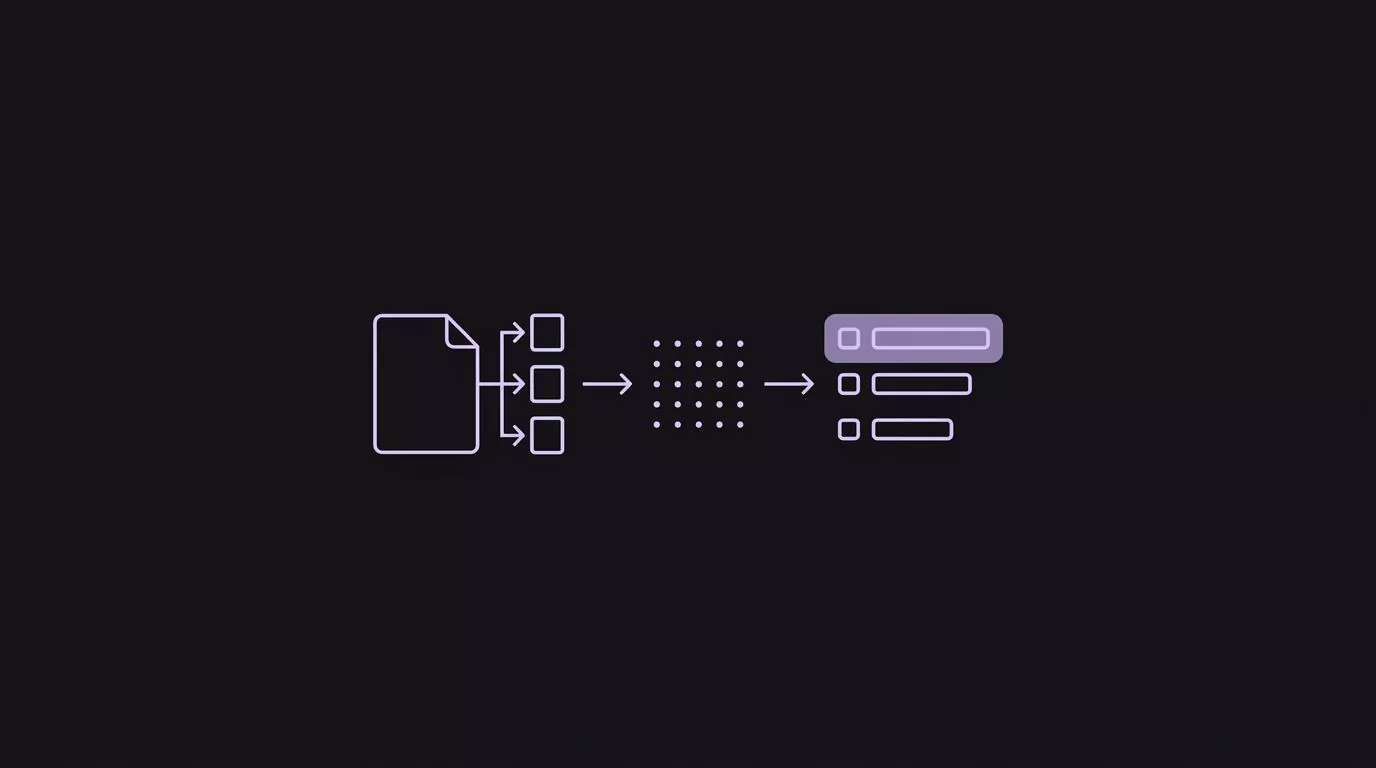
Notice what is missing. Nothing in that chain reads your intro, your title, or the paragraph just above the block. The block travels alone.
Your headings shape where those cuts land. Most splitters break on heading tags first, then on paragraph breaks. A clear H2 every 200 to 300 words gives the splitter clean seams to work with. A wall of text under one heading gets sliced mid-thought instead.
Anthropic put a number on the damage in a note on contextual retrieval. One of their sample blocks reads: "The company's revenue grew by 3% over the previous quarter." Which company? Which quarter? The block cannot say.
When they fed context back into each block, misses fell by 35%. Adding a second scoring pass pushed the drop to 67%. That test was built for internal search tools, not blogs. The lesson still carries. A block that names its own subject is easier to find and safer to quote.
Research points the same way. The GEO study from KDD 2024 tested content edits against AI answer engines. Adding quotes, stats, and clear sources raised visibility by up to 40%.
So the unit of search visibility is no longer the page. It is the passage. That single change is what makes SEO for AI search feel new.
Five Edits That Make a Passage Quotable
These five edits do the heavy lifting. Everything else is polish.
1. Make each passage stand on its own
Read any paragraph with the rest of the page hidden. Can a stranger tell what it is about? If not, that block is dead weight in the index.
Fix it by repeating the subject. Write "Stripe Billing" again instead of "the tool". Write "in 2026" instead of "this year". It feels clunky when you read top to bottom. It reads fine when the block stands alone.
2. Answer first, in 40 to 80 words
Put the direct answer in the first sentence under the heading. Then add the detail. A model that needs a short quote will take your opening lines.
Keep that answer between 40 and 80 words. Shorter blocks lack the detail to win. Longer blocks get cut in odd places.
Here is the pattern in miniature. A heading asks "How much does a content audit cost?" The weak version opens with "It depends on a few things". The strong version opens with "A content audit costs $1,500 to $6,000 for a site under 200 pages". Only one of those can be quoted.
3. Name the subject instead of pointing at it
Pronouns are the top cause of broken blocks. "It", "this", "they", and "the above" all point at text the model may never see.
Swap them for nouns. "This helps a lot" becomes "Answer-first writing helps a lot". You lose a little flow and gain a passage that can travel.
4. Give the model something only you have
Generic advice is not worth quoting. A thousand pages already say it. Original numbers are worth quoting, and so are named tools, dated tests, and real prices.
Run a small test and report the result. Pull a figure from your own dashboard. One honest stat you own beats ten borrowed from the same roundups everyone cites.
5. Keep entity names identical everywhere

Pick one name for your product and never drift. If the brand is "Lunroo", do not write "Lunroo AI" on one page and "the Lunroo app" on the next.
Models tie citations to entities. Three spellings split your credit three ways. The same rule covers author names, plan tiers, and feature names.
A Real Before and After Rewrite
Here is the part no page on this topic shows. Below is a composite example, built from patterns that turn up constantly in SaaS help content. The product name is invented, so no real team gets called out. Read the first version as if you landed on it cold.
Before
Setting this up is pretty simple. Once you have it enabled, the system will start tracking automatically in the background. Most people find that it takes about a week before the data becomes useful.
You can then use it to spot the bottlenecks. This is where teams usually see the biggest wins. We have seen it cut cycle time quite a bit for some of our customers.
Keep in mind that the above only applies to the newer plans. Older accounts work a little differently, so check with support if you are unsure.
If none of that helps, our support team is happy to walk you through it. They can also turn it on for you if you would rather not dig through the menus yourself.
Count the problems. The section never names the product. It never names the feature. "This", "it", and "the system" carry the whole passage. "Quite a bit" is the only result on offer, and "the above" ties the third block to the second. Lift any one of these blocks out and it says nothing.
After
Cycle time tracking in Fernpath starts logging within one week. Turn it on in Settings, then let it run. Fernpath needs about seven days of ticket history before the first report is worth reading.
Once the report fills in, Fernpath flags the slowest stage in your workflow. In a 2026 audit of 40 Fernpath accounts, teams that fixed the top flagged stage cut median cycle time from 9.2 days to 6.4 days.
Cycle time tracking is available on Fernpath Growth and Fernpath Scale plans only. Fernpath Starter accounts do not include it.
To switch cycle time tracking on, open Settings, choose Workflow, then toggle Cycle time tracking. Fernpath support can enable it for accounts on annual billing, where the setting is locked by default.

Which Edits Actually Changed What Gets Quoted
| Edit | Does it change what a model can lift? |
|---|---|
| Naming Fernpath in every paragraph instead of "it" and "the system" | Yes. Each block now names its own subject. |
| Leading with the answer in the first line | Yes. It hands the model a clean 40 to 80 word quote. |
| Replacing "quite a bit" with 9.2 days to 6.4 days | Yes. An original number is worth citing. |
| Swapping "the above" for the plan names | Yes. The block no longer depends on the one before it. |
| Naming the exact menu path in Settings | Yes. It turns a vague step into a quotable instruction. |
| Splitting long sentences | No. It helps human readers, not retrieval. |
| Bolding the opening line | No. Models read the text, not the weight. |
Five of those seven edits change what a model can lift. Two just look tidier. That ratio is normal. Most of your editing time should go into naming things and adding numbers.
The rewrite also got longer, and that is fine. Self-contained writing repeats nouns that a human reader could infer. You are paying a small tax in word count to buy a passage that survives on its own.
How to Optimize Content for LLMs in One Editing Pass

One reviewer can run this list on a draft in about ten minutes:
- Hide the page and read three random paragraphs. Does each one name its own subject?
- Under every question heading, is the answer inside the first 40 to 80 words?
- Search the draft for "it", "this", and "the above". Replace the vague ones.
- Count the original numbers. Aim for at least two a reader cannot get elsewhere.
- Check that brand, plan, and feature names match the rest of the site.
- Confirm each heading reads like a question a real person would type.
Run it on new drafts first. Then work backward through your best pages. Posts that already rank tend to win citations fastest, so start there.
Track the result in two cheap ways. Check your server logs or analytics for referrals from chatgpt.com and perplexity.ai. Then ask each tool a handful of questions you should own, and note whether your site shows up in the sources.
Both signals are rough. Referral counts stay small even when citations are working, because most AI answers never get clicked. Read the trend across a month rather than any single day.
None of this replaces normal on-page work. Google's own notes on AI features in Search still ask for the same basics: useful pages that crawlers can reach. You also still need keyword research and a clear content strategy underneath all of it.
Keeping This Consistent Across a Whole Library
One article is easy. Two hundred is the real problem.
Passage rules only pay off when every page follows them. Miss a few and your citations stay patchy. Most teams start strong, then drift once the calendar gets tight.
A shared checklist helps. It still leans on one person to apply it every single time. That is why it pays to bake the rules into your content workflow rather than trust memory.
Lunroo handles this step with an Editor agent. It scores every draft for SEO and readability, fixes structure, links, and meta tags, then holds the post at an approval gate until you sign off. It writes in your brand voice and publishes around 30 articles a month to WordPress, Webflow, Ghost, Shopify, Framer, Wix, or a webhook.
It is not an agency. There is no human strategist, no PR, and no paid ads. Social and email repurposing sit on the roadmap, not in the product today. What it does cover is the research to publish loop, at $199 a month plus VAT, with the first month at $99 and no lock-in.
Curious what a library edited to one standard looks like? See how SEO automation works in practice, or how AI marketing agents fit a lean team.
Frequently Asked Questions
How do you get cited by ChatGPT?
To get cited by ChatGPT, write passages that answer one question fully and name their own subject. ChatGPT pulls short blocks, so a block that leans on earlier text rarely survives the trip. Add original numbers and keep your brand name spelled the same way across the site. The same rules cover how to rank in ChatGPT search results.
Is LLM SEO different from normal SEO?
LLM SEO shares most of its base with normal SEO. You still need crawlable pages, useful content, and links. The difference is the unit of work. Classic SEO tunes a page to rank. LLM SEO tunes each passage to be lifted out and quoted on its own.
How do you rank on Perplexity?
Perplexity leans on live retrieval and shows its sources, so clear structure counts more than raw domain strength. Use question shaped headings, answer in the first 40 to 80 words, and include dates and figures. Pages that are easy to quote get pulled more often.
Does schema markup help with AI search?
Schema markup helps search engines read your page, and Google still uses it for rich results. Its direct effect on chatbot citations is unproven. Treat it as good hygiene rather than the main lever. Clear writing and self-contained passages do more for you.
How long does it take to see AI citations?
Most teams see movement within a few weeks on pages that already rank. AI tools tend to pull from sources they can find and trust, so existing winners get cited first. Brand new pages take longer, in line with normal SaaS SEO timelines.