How to Write SEO Content in 2026: A Step-by-Step Guide
Here's the short version of how to write SEO content: pick one keyword, understand what the searcher actually wants, build your outline from the pages already ranking, then write something clearer and more useful than they did. Everything else is detail.
The problem is that most guides stop at "write good content" and leave you guessing at the process. This one gives you the full loop — research, intent, structure, on-page, editing, and tracking — as a repeatable system you can run every time. No prior SEO experience assumed.
Let's break this down into six steps you can follow start to finish, then look at how to run it at scale without dropping quality.
What "SEO content" actually means (and what it doesn't)
SEO content is content written to rank in search engines for a specific query while genuinely answering it. That second half matters. If you write for the algorithm and ignore the reader, you get thin pages that spike and then sink.
What it is not: keyword stuffing, spinning up 500 near-identical pages, or gaming a metric. Google's systems reward pages that satisfy the person who clicked, and increasingly so do AI Overviews and answer engines that pull passages directly into results.
The mental model to hold onto is this — you're writing for a human first, then formatting it so a machine can understand and trust it. Get both right and you rank. Get only the machine part right and you don't last.
If you're newer to this, our beginner's guide to how to rank on Google covers the ranking fundamentals underneath everything below.
Step 1: Do keyword research and pick one primary keyword
Every ranking page starts with one target keyword. Not five — one. That keyword becomes the page's job, and every other decision serves it.
Good keyword research balances three things:
- Search volume — enough people search it to be worth the effort
- Keyword difficulty — you can realistically compete for it given your site's authority
- Intent match — you can actually satisfy what searchers want (more on that in Step 2)
For a newer site, chase lower-difficulty, longer-tail terms first. "How to write SEO content for beginners" will be easier to win than "SEO," and the traffic converts better because the intent is specific.
Pull related terms while you're here. For this page, adjacent phrases like "seo content writing for beginners" and "how to write content for seo" all point at the same underlying need — capture them as subtopics rather than separate pages. If you want the full method, we wrote a step-by-step keyword research guide that goes deeper than we can here.
Pro tip: check the yearly trend on a keyword, not just the monthly volume. A term that's declining year over year is a supporting piece, not a pillar to build your strategy around.

Step 2: Match search intent before you write a word
Search intent is what the person actually wants when they type the query. Get this wrong and it doesn't matter how well you write — you're answering a question nobody asked.
There are four common intents:
- Informational — learning something ("how to write SEO content")
- Commercial — comparing options ("best content writing tools")
- Transactional — ready to act ("hire SEO writer")
- Navigational — looking for a specific brand or page
The fastest way to read intent is to search your keyword and look at what already ranks. If the top ten are all step-by-step guides, Google has told you the intent is a how-to. Publishing a product page there won't work no matter how good it is.
Also note the format Google is rewarding — listicles, long guides, videos, comparison tables. Match the dominant format, then do it better. This is where a lot of otherwise-solid content fails: right keyword, wrong intent.

Step 3: Build an outline from the SERP and People Also Ask
Now you reverse-engineer the outline. Open the top-ranking pages and note the subtopics they all cover. Those shared sections are the baseline you have to hit to be considered relevant.
Then find the gaps. The pages ranking for "how to write SEO content" almost all teach the same generic steps — few show how to turn those steps into a repeatable workflow, and many predate AI Overviews entirely. Gaps like these are your opening to write something more complete.
People Also Ask is a goldmine here. The questions Google surfaces — "What is SEO content writing?", "How long should SEO content be?", "Can AI write SEO content?" — are real demand you can answer directly, often in an FAQ section (which is also where structured Q&A gets picked up by AI answers).
Your outline should end up as a set of H2s that cover the shared subtopics, close the gaps, and answer the top PAA questions. For a bigger-picture view of how individual pages fit together, see how to build a content strategy.
Step 4: How to write SEO content that reads well — structure, headers, and readability
With an outline in hand, drafting gets much faster. A few rules keep SEO content readable and rank-worthy.
Front-load the answer. Put a concise, direct answer near the top — ideally in the first paragraph. This helps the reader and gives AI Overviews a clean passage to cite. Notice how this article opened with "the short version" before any explanation.
Use headers as a skeleton. One H1 (your title), descriptive H2s for main sections, H3s for subsections. Work your primary keyword into the H1 and at least one H2 naturally — never forced.
Keep paragraphs short. Two to three sentences. Walls of text kill readability on mobile, where most of your traffic lives.
Write like a person. Use "you." Choose plain words over jargon. Add the "why it matters" behind each piece of advice so it sticks.
For a walkthrough of these drafting principles in action, this tutorial on content writing for SEO is a useful companion to this step:
On length: write as much as the topic needs to fully answer it, and no more. There's no magic word count — a focused 1,200-word piece beats a padded 3,000-word one every time. Let the SERP guide you; if the top results run long, the topic probably warrants depth.Step 5: Optimize on-page (title, meta, internal links, images)
On-page optimization is the machine-readable layer. It's quick, it's mechanical, and skipping it leaves easy rankings on the table.
Run through this checklist for every page:
- Title tag — include the primary keyword, keep it under ~60 characters, make it click-worthy
- Meta description — under ~155 characters, describe the value, include the keyword (it won't rank you but it lifts click-through)
-
URL slug — short and keyword-bearing (
/how-to-write-seo-content) - Internal links — link to related pages on your site with descriptive anchor text
- Image alt text — describe each image for accessibility and image search
- Primary keyword placement — in the first 100 words, one H2, and naturally throughout
Internal links deserve a callout. They pass authority between your pages and help both readers and crawlers understand how your content connects. Link generously to genuinely relevant pieces — the way this guide links to keyword research and content strategy. If you want the mechanics in one place, how to rank on Google covers on-page in more detail.
Step 6: Edit for E-E-A-T, then publish and track performance
The draft is done. Before it ships, edit for E-E-A-T — Experience, Expertise, Authoritativeness, and Trustworthiness. This is Google's shorthand for content it can trust, and it's what separates content that ranks from AI-generated filler.
Concretely, that means:
- Add first-hand experience, specific examples, and real numbers
- Make claims accurate and, where useful, cite a credible source
- Give the piece a real author with a real bio
- Cut fluff, filler, and anything you can't stand behind
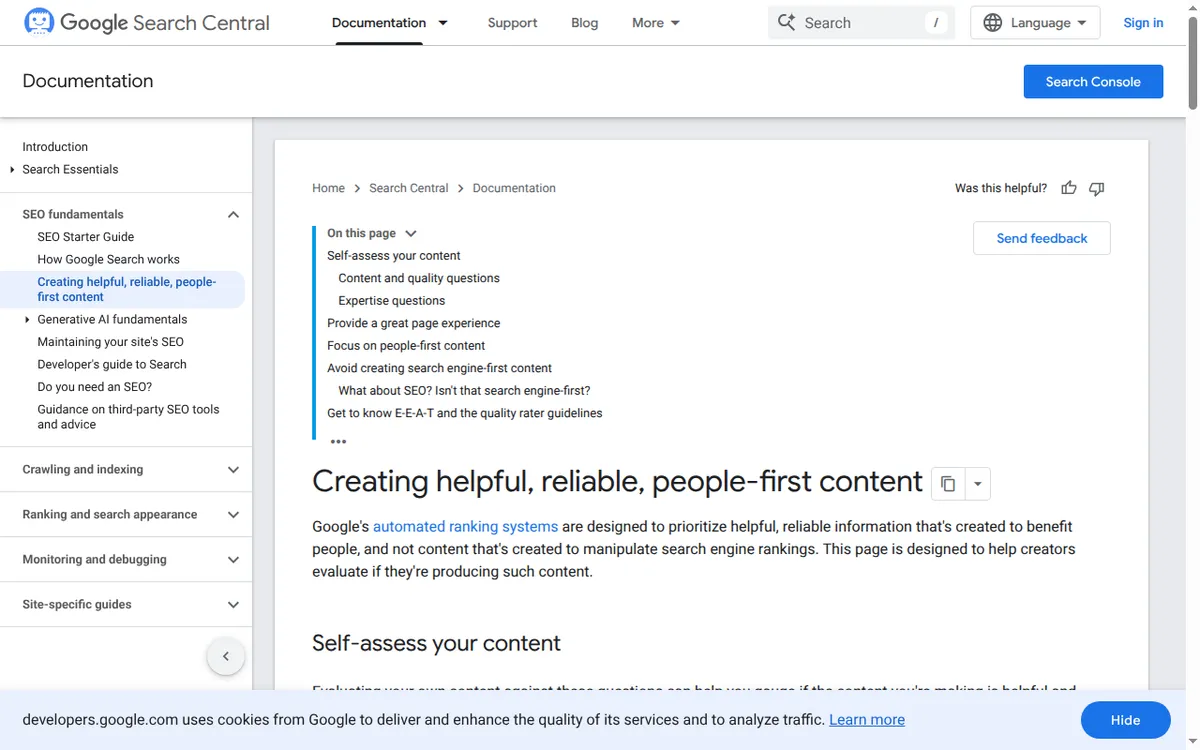
This is also the single most important guardrail if you draft with AI. AI is a fast first-drafter, but a human should approve every claim before it publishes — Google's own helpful content guidance is clear that people-first, trustworthy content is what wins, regardless of how it's produced.
Once it's live, track it. Watch impressions, clicks, average position, and click-through rate over the following weeks. Rankings take time — often weeks to months — so don't panic at day-three numbers. Update the pages that stall and double down on the ones that climb.
Scaling SEO writing without losing quality
Here's where most teams hit a wall. The six steps above are straightforward for one article. Running them every week, across a dozen topics, while keeping quality high — that's the actual hard part.
The steps don't change; the challenge is coordination. Keyword research has to feed the outline, the outline has to feed the draft, the draft has to get optimized and edited, and none of it can drift out of sync. Doing that by hand across a backlog is where good intentions go to die.
This is the coordination Lunroo's multi-stage workflow was built for. Research handles keyword targets, SERP analysis, and intent. Drafting turns the brief into a full piece. Editing optimizes on-page and checks quality. Publishing ships it once you've approved. The same six steps, sequenced end to end as one continuous loop. It's Notion-native, so the work happens where you already plan.
The part that matters for E-E-A-T: nothing publishes on its own. Every draft lands in your Notion in draft mode for you to approve, edit, or reject. You keep editorial control and the trust signals that rankings depend on, and the automation removes the grunt work. If you want the deeper picture of how that works, read how AI agents automate marketing, or see how to automate SEO for the SEO-specific version.
A repeatable process is what separates content that ranks from content that gets buried. If you'd rather have that process run end to end with you approving every draft, start with Lunroo — or see current pricing for the plan details.
FAQ
What is SEO content writing?
SEO content writing is the practice of creating content designed to rank in search engines for a specific query while genuinely answering it. It combines keyword research, search intent matching, clear structure, and on-page optimization.
The goal is to satisfy both the reader and the search engine. Content that only targets keywords without helping the reader tends to rank briefly and then fall, so the "writing" half matters as much as the "SEO" half.
How long should SEO content be?
There's no magic number. Write as long as the topic needs to fully answer the query, and no longer. A focused 1,200-word guide often outperforms a padded 3,000-word one because it respects the reader's time.
The best signal is the SERP itself. Look at the pages currently ranking for your keyword — if they run long and comprehensive, the topic likely warrants depth. If they're short and direct, match that.
Can AI write SEO content?
Yes, AI can draft SEO content quickly, and it's a strong first-drafter for research and structure. But a human should review and approve every draft before it publishes — checking claims for accuracy, adding real experience and examples, and ensuring the piece meets E-E-A-T standards.
Google rewards people-first, trustworthy content regardless of how it's produced. The winning approach is AI for speed with human judgment for quality and trust — which is exactly the draft-and-approve model tools like Lunroo are built around. Our guide to AI writing tools compares the options.
How do you write SEO content for beginners?
Start small and follow the process in order: pick one low-difficulty keyword, check what already ranks to understand intent, outline from those pages plus People Also Ask, write a clear draft that front-loads the answer, then handle on-page basics like the title tag and internal links.
Don't try to master everything at once. Publish a few pieces, track how they perform, and improve from real data. The keyword research guide is a good next read once you've got the workflow down.
How is SEO content different from regular content?
Regular content is written to inform, entertain, or persuade without necessarily targeting a search query. SEO content does all of that but is also built around a specific keyword and structured so search engines can understand, index, and rank it.
In practice the difference shows up in the process — SEO content starts with keyword research and intent analysis before a word is written, and finishes with on-page optimization and performance tracking. A strong content marketing workflow bakes those steps in by default.