SEO for SaaS: A Founder's Playbook for Compounding Growth
SEO for SaaS is one of the few channels that gets cheaper as it grows. You write a page once, it ranks, and it keeps sending you buyers while you sleep — no ad spend, no cold outreach, no burning cash per click. For a founder with more product to build than budget to spend, that compounding is hard to beat.
The good news is that SaaS is a genuinely winnable game right now. The keyword you're reading a page about — "seo for saas" — has a keyword difficulty of 12 and low competition, which is proof that useful, well-targeted content still ranks without a fat backlink budget. The hard part isn't knowing what to do. It's finding the bandwidth to actually do it.
Let's break this down into a playbook you can run yourself.
## Why SEO for SaaS is different (and why founders win at it)SaaS SEO doesn't behave like e-commerce or local SEO, and treating it the same way is the first mistake most founders make.
The buying cycle is long. Someone might read your comparison page in March and only swipe a card in June, after three demos and a Slack debate with two colleagues. There are usually multiple decision-makers — the engineer who trials it, the manager who approves it, the finance person who signs. Your content has to serve all of them at different moments.
That changes what "good" content looks like. E-commerce SEO chases transactional queries with product pages. Local SEO chases "near me" intent. B2B SaaS SEO chases jobs to be done — the problems your product solves — and meets buyers with content long before they're ready to buy.
Here's why founders actually have an edge: you know the problem better than any agency copywriter ever will. You've talked to the customers. You know the objections, the workarounds, the competitor everyone secretly uses. That product-led knowledge is exactly what separates content that ranks and converts from generic SEO filler.
The SaaS SEO funnel: mapping keywords to buyer intent
Before you write a word, map keywords to where the buyer is. A good saas seo strategy assigns every page a job in the funnel.
- Top of funnel (TOFU): Problem-aware searches. "How to reduce churn," "what is product-led growth." High volume, low direct intent. This is where you build authority and catch buyers early.
- Middle of funnel (MOFU): Solution-aware searches. "Best churn analytics tools," "customer retention software." The reader knows a category exists and is comparing options.
- Bottom of funnel (BOFU): Product-aware, high-intent searches. "[Competitor] alternative," "[Your category] pricing," integration and use-case pages. Lower volume, but these convert.

The trap is spending all your energy at the top because the volume looks exciting. Traffic doesn't pay salaries. Start at the bottom, where a page with 100 monthly searches and buying intent can outperform a viral TOFU post that converts nobody.
BOFU pages that punch above their weight for SaaS:
- Comparison pages — "X vs Y," honest side-by-side breakdowns.
- Alternative pages — people actively shopping for a switch.
- Integration pages — "[Your product] + Slack," capturing existing-tool searches.
- Use-case pages — "[Your product] for agencies," matching buyer segments.
If you want to go deeper on matching search terms to intent, our guide on how to do keyword research walks through the sorting process step by step.
Step 1: Keyword research that targets revenue, not traffic
The single biggest lever in a saas seo checklist is picking the right keywords. Aim for terms that are commercial, low-difficulty, and close to your product.
Start with the criteria that matter for a small SaaS:
- Low keyword difficulty (KD). For a newer domain, hunt for KD under 20. These are winnable without a huge link profile.
- Commercial or product-led intent. A high CPC is a signal, not a warning — it means businesses pay to reach those searchers. "Seo for saas" carries a $46 CPC precisely because the audience is valuable.
- Proximity to your product. If the searcher's problem is one your product solves, the click is worth more than ten unrelated visitors.
"Seo for saas" itself is the proof: KD 12, low competition, commercial intent. Low-difficulty commercial wins genuinely exist — you just have to look past raw volume to find them.
Build your list from three sources: your product's jobs-to-be-done, competitor keywords (what are they ranking for that you aren't?), and long-tail variations of your BOFU terms. Then sort ruthlessly by winnability times revenue potential. If you'd rather not do this by hand every month, how to automate SEO covers where the research grind can be handed to software.
Step 2: Building topic clusters and a content engine
One-off blog posts don't build a moat. Clusters do.
The pillar-and-cluster model is simple: a broad pillar page targets your main term (say, "saas seo strategy"), and a set of cluster pages each target a specific sub-topic and link back to the pillar. Google reads the internal linking as a signal that you have genuine depth on the subject, and the cluster lifts the whole group.

For a founder, the real question is cadence. Don't promise yourself ten posts a month and burn out by week three. A sustainable saas seo roadmap for one person looks more like:
- Publish one strong cluster page a week — quality over volume.
- Refresh one older page a month — SaaS content decays; updated pages often out-rank new ones.
- Interlink as you go — every new page links to two or three siblings.
That's roughly 50 durable pages a year, all reinforcing each other. It beats 200 thin posts that rank for nothing. For the planning side of this, how to build a content strategy and content marketing for startups go deeper on turning a keyword list into a shippable calendar.
The refresh loop matters more than founders expect. Search results shift, competitors publish, your product evolves. Set a recurring reminder to revisit your top ten pages quarterly and update stats, screenshots, and internal links.
Step 3: Technical SEO foundations you can't skip
You don't need enterprise technical SEO. You need to not shoot yourself in the foot. Keep this founder-sized.
-
Crawlability. Make sure Google can find and read your pages. A clean sitemap, no accidental
noindextags, and a sane URL structure cover most of it. - Site speed. Core Web Vitals affect rankings and conversions. Compress images, lazy-load below the fold, and don't ship a 3MB hero video. Most SaaS marketing sites win here by simply not being bloated.
- Programmatic-page hygiene. If you generate pages at scale — integration or use-case pages from a template — guard against thin, near-duplicate content. Each page needs a genuine reason to exist. Our programmatic SEO guide covers how to scale pages without tripping Google's quality filters.
- Schema markup. Add structured data for articles, FAQs, and products so search engines (and AI answer engines) can parse your content. It's a small effort with outsized visibility payoff.
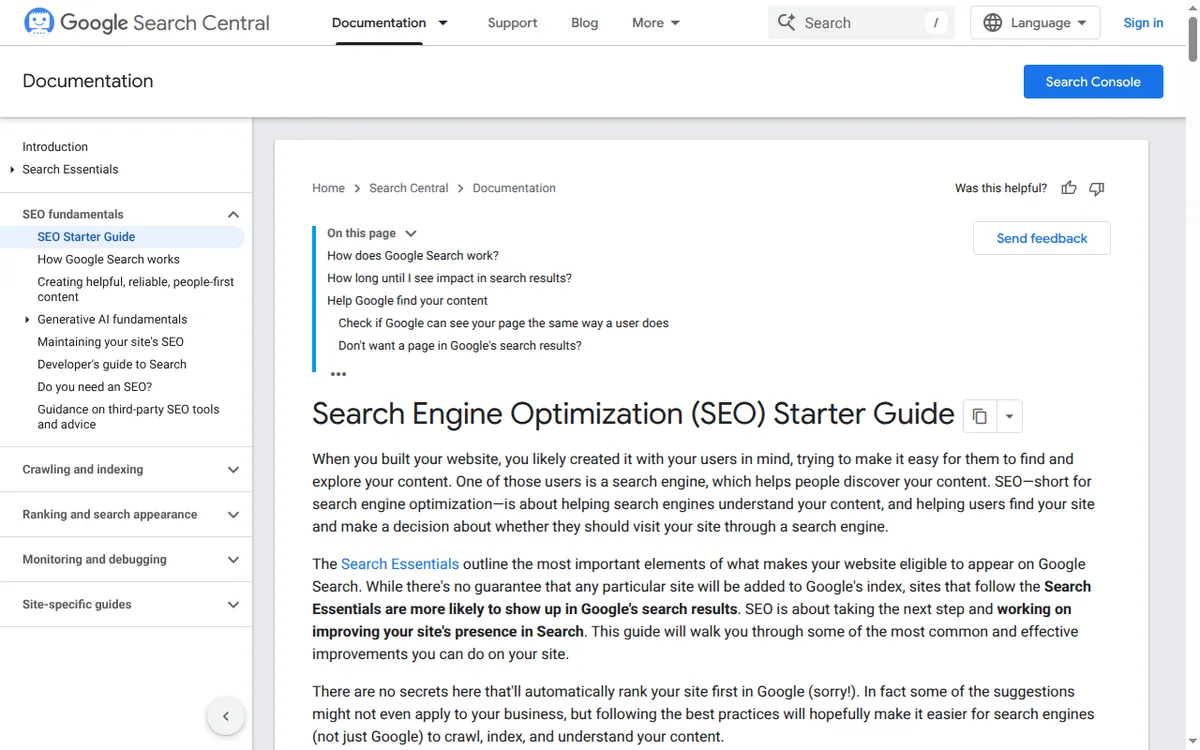
For the authoritative reference on what actually influences rankings, Google's own Search Central documentation is the source of truth — bookmark it and skip the second-hand hot takes.
Step 4: On-page and AI answer-engine optimization
On-page SEO is the part you control completely, so get it right every time.
The fundamentals still hold: one primary keyword per page, in the title, the H1, the first 100 words, and at least one subheading. Write for humans first — clear structure, short paragraphs, real answers up top. Add internal links to related pages and descriptive alt text on images.
But 2026 added a second channel you can't ignore. B2B buyers increasingly start their research inside AI answer engines — Google's AI Overviews, ChatGPT, Perplexity — not the classic blue links. If your content isn't structured to be quoted by an LLM, you're invisible to a growing slice of your market.
Optimizing for both at once (sometimes called GEO, generative engine optimization) comes down to a few habits:
- Answer the question directly, early. Lead with a clear, self-contained answer an LLM can lift as a citation.
- Use clean structure. Headings phrased as questions, short definitional sentences, and lists are easy for models to parse and reuse.
- Add FAQ schema. It feeds both Google's People Also Ask and AI answer engines.
- Be specific and factual. Concrete numbers and named examples get cited; vague fluff gets ignored.
The upside: the same content discipline serves Google rankings and AI visibility. You're not doing two jobs — you're doing one job well.
How to actually ship this without an agency (the Lunroo angle)
Here's the honest part. Everything above is knowable in an afternoon. The reason SaaS SEO stalls for founders isn't a knowledge gap — it's a bandwidth gap.
Look at what this playbook actually requires: someone to research keywords, someone to draft the pages, someone to edit them into shape, and someone to track rankings and decide what to refresh. That's four jobs. As a founder, you're also building product, talking to customers, and running the company. SEO is the thing that quietly slips to next week, every week.
You have three options. Hire a marketing person (expensive, slow to ramp). Retain an agency (costly, and they don't know your product like you do). Or automate the repetitive parts and keep the judgment for yourself.
That last path is what Lunroo is built for. Instead of one AI prompt box, it runs the whole content pipeline end to end as distinct stages: research finds the keyword and topic targets, drafting writes the pages in your brand voice, editing optimizes them, and publishing ships them on schedule. It's the whole playbook above, running as one loop — and it lives Notion-native, so it plans and publishes where you already work.
The part founders care about most: nothing ships without you. Every draft lands in a review step, and you approve, edit, or reject before anything goes live. It's automation with a human-in-the-loop, not automation you have to babysit or blindly trust. If you want the deeper mechanics, how AI agents automate marketing and what are AI marketing agents explain how the coordination actually works.
If you'd rather watch an automated workflow draft your first SaaS SEO piece than stare at a blank page, start with Lunroo. The playbook doesn't change — you just stop being the bottleneck.
FAQ
What is SaaS SEO?
SaaS SEO is the practice of getting a software product's website to rank in search engines for the terms its buyers use. It differs from general SEO because it targets long, multi-touch B2B buying cycles and leans heavily on product-led content — comparison pages, alternative pages, integration pages, and use-case pages — that meets buyers at every stage from problem-aware to ready-to-buy.
How long does SEO take for a SaaS?
Realistically, expect three to six months to see early movement and 6 to 12 months for compounding results. New pages take time to crawl, index, and earn trust, and SaaS buying cycles are long, so ranking is only half the wait — conversion lags too. The upside is durability: unlike ads, the traffic keeps coming after you stop actively working on each page. Start now, because the clock only runs once you publish.
Is SEO worth it for a B2B SaaS startup?
For most B2B SaaS, yes. Organic search compounds — each ranking page keeps working indefinitely, so your cost per acquired customer drops over time instead of rising like paid channels. It's especially worth it when your buyers actively research solutions in Google and AI answer engines, which nearly all B2B buyers now do. The main cost is patience and consistent execution, not cash.
How much should a SaaS spend on SEO?
It depends on whether you're spending money or time. A founder doing it themselves spends mostly hours; the cash cost is a few tools. Agencies typically run several thousand dollars a month and don't know your product as well as you do. Automating the pipeline with an agent platform sits in between — one subscription instead of a copywriter plus an SEO retainer plus a stack of tools. See current pricing for how that compares.
Can you do SaaS SEO without an agency?
Absolutely. The knowledge in this playbook is enough to run SaaS SEO yourself — the real constraint is bandwidth, not expertise. Founders who ship consistently, even one strong page a week, routinely out-rank companies paying agencies. If bandwidth is the blocker, automating the research-draft-edit-track loop (with you approving the output) gets you agency-level throughput without handing over control. Our SEO for startups guide covers the solo-founder version in more detail.