How to Build a Content Strategy: A Step-by-Step Guide
Here's the short version of how to build a content strategy: decide what business outcome you want, learn what your audience is actually searching for, pick a small set of topics you can own, and ship on a cadence you can sustain. The steps below walk through each one.
Most guides on this topic are written for enterprise marketing departments. This one is written for the reality of a small team — two to six people who own the strategy and the execution, and who don't have a copywriter, an SEO specialist, and a data analyst waiting down the hall. For you, knowing the steps was never the hard part. Running them every single week is.
Let's break this down.
## How to build a content strategy: what it actually is (and why small teams skip it)A content strategy is the plan that connects your business goals to the content you publish and how you measure whether it worked. It answers three questions: who are we writing for, what are we writing about, and how do we know it's paying off.
It is not a content calendar. A calendar tells you what publishes on Tuesday. A strategy tells you why that piece exists and what it's supposed to earn. The calendar is downstream of the strategy — one of the last things you build, not the first.
Small teams skip this step for an understandable reason: it feels like overhead when you're already behind on publishing. So you write reactively — a post because a competitor did, another because someone on the team had an idea in Slack. Ad-hoc publishing burns your two scarcest resources, time and attention, on content that doesn't compound.
The cost is quiet but real. Without a strategy you can't tell a winning topic from a lucky one, you can't say no to low-value requests, and every piece starts from a blank page instead of a plan. A strategy is what turns scattered posts into an asset that grows.
Step 1: Define goals and how you'll measure them
Start with the business objective, not the content. Are you trying to generate demo signups, build organic traffic to lower paid acquisition costs, or establish authority in a new category? Different goals produce different content.
Pick two or three KPIs — no more. A small team that tracks fifteen metrics tracks none of them. Good starting sets:
- Demand goal: organic signups, demo requests, qualified leads from content
- Traffic goal: organic sessions, keyword rankings, share of search in your niche
- Authority goal: branded search volume, backlinks earned, newsletter subscribers
Then benchmark where you are today. Pull your current organic traffic, your top-performing pages, and your baseline conversion rate before you change anything. Without a baseline you can't prove the strategy worked, and proving it worked is how you protect the time to keep doing it.
Pro tip: attach a rough target and a date to each KPI. "Grow organic signups from 20 to 60 a month by Q1" is a goal. "Get more traffic" is a wish.
Step 2: Audit your existing content
Before you plan new content, take inventory of what you already have. Most teams are sitting on more value than they realize — and more dead weight.
Export every URL and tag each one on two axes: performance (traffic, rankings, conversions) and funnel stage (awareness, consideration, decision). A simple spreadsheet does the job. Then sort every piece into one of three buckets:
- Keep — performing well, still accurate. Leave it, and note what makes it work.
- Update — good topic, stale or thin execution. Refreshing an existing page is often the highest-ROI content work you can do, because it already has some authority.
- Kill — no traffic, off-strategy, or redundant. Redirect it or remove it so it stops diluting your site.
The audit does double duty: it shows you what topics already resonate with your audience, and it usually surfaces a few quick wins you can ship while the rest of the strategy comes together.
Step 3: Understand your audience and their search intent
You can't write for everyone, so define who you're writing for. Sketch your ideal customer: their role, the job they're trying to get done, and the specific pains that bring them to a search bar. If you have sales calls or support tickets, mine them — they're full of the exact language your audience uses.
Then connect those pains to real queries. This is where search intent comes in, and where most competing guides go vague. It's not enough to know your audience cares about "content marketing." You need to know whether they're typing "what is content marketing" (they want a definition), "content strategy template" (they want a tool), or "surferseo alternative" (they're comparing options and close to buying).
That mapping is what keyword research gives you: the actual phrases, their volume, and the intent behind them. Match each pain point to the query your reader uses and the format that satisfies it — a guide, a comparison, a template, a checklist.
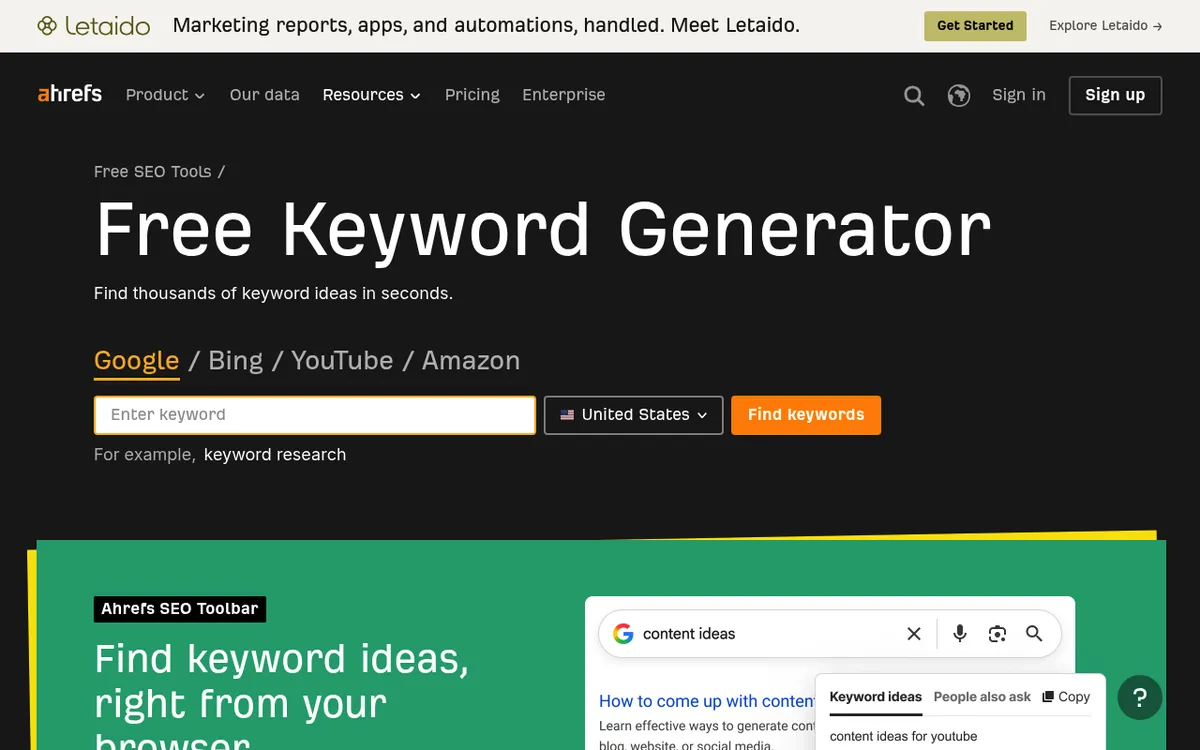
A free keyword tool like this turns a vague topic into a ranked list of real queries and their search volume — the raw material for your topic map.
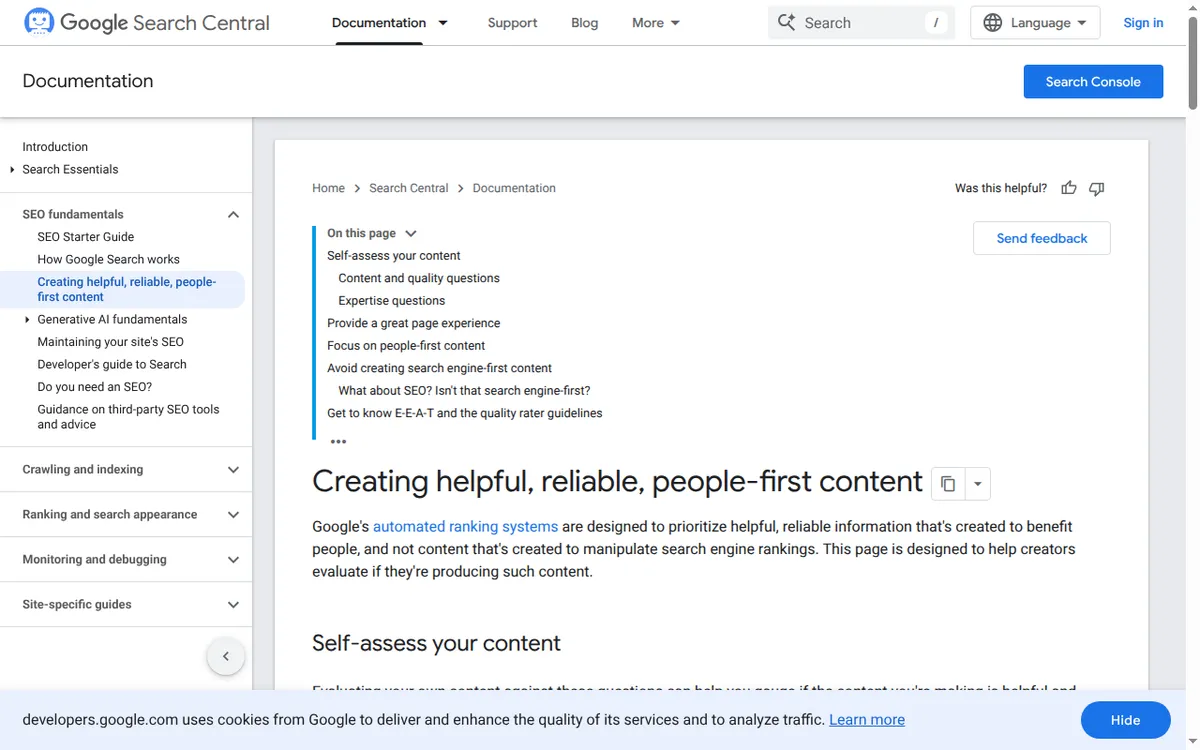
Getting intent right is also what makes a page rank. Google's own guidance is to create helpful, people-first content that matches what the searcher wanted — so writing SEO content starts with understanding intent, not stuffing keywords.
Step 4: Choose your topics, clusters, and channels
Now turn queries into a topic map. The most durable structure for a small team is the topic cluster (or pillar) model: one comprehensive "pillar" page on a broad topic, surrounded by focused posts that each target a specific sub-query and link back to the pillar.

The cluster model works because it concentrates your authority instead of scattering it. Ten related posts that link to each other and to a central page build far more topical weight than ten unrelated posts. It also makes planning easier — you're filling in a map, not brainstorming from zero each week.
Prioritize topics on two axes: intent value (how close is this reader to buying?) and effort (can we produce something genuinely better than what ranks now?). Start where high intent meets low competition. For most small teams that means long-tail, specific queries — not the head terms every enterprise blog already owns.
On channels, be honest about capacity. Pick the one or two you can sustain — usually your blog plus one distribution channel — rather than spreading thin across six. It's better to own one channel than to be forgotten on five.
Step 5: Set voice, format, and an editorial workflow
Consistency is what makes content feel like your brand instead of a pile of posts. Write down your voice: how you sound, words you use, words you avoid, and how you reference your product. A one-page guide is enough, and it saves hours of back-and-forth on every draft.
Standardize your formats too. Decide what a how-to looks like, what a comparison looks like, what your standard intro and CTA patterns are. Templates make writing faster and quality more predictable — exactly what a small team needs.
Then define the workflow, because this is where strategies live or die. A repeatable pipeline looks like:
- Brief — target keyword, intent, outline, internal links
- Draft — written to the brief and the voice guide
- Edit — fact-check, tighten, optimize on-page
- Approve — a human signs off before anything publishes
- Publish and link — ship it and wire up internal links
Write this down and assign an owner to each stage. For a deeper version, see our guide to a repeatable content marketing workflow. The point is that every piece moves through the same path, so nothing gets stuck in one person's head.
Step 6: Build a content calendar and ship consistently
Now — and only now — you build the calendar. With goals, topics, and a workflow in place, the calendar is just scheduling.
The most important word here is realistic. One well-researched, genuinely useful post a week beats four thin ones. Consistency compounds; bursts followed by silence do not. Set a cadence your team can hold during a busy month, not just a quiet one.
A few tactics that keep a small team shipping:
- Batch by stage. Outline three pieces in one sitting, draft in another. Context-switching is the silent tax on small teams.
- Assign a single owner per piece. Shared ownership means no ownership.
- Keep a buffer. Stay two to three pieces ahead so one bad week doesn't break the streak.
If you want the full mechanics, we cover it in how to create a content calendar. The calendar isn't the strategy — it's the strategy made schedulable.
Step 7: Measure, report, and iterate
A content strategy is a loop, not a launch. Every month, pull the two or three KPIs you chose in Step 1 and compare them to your baseline.
Look for patterns, not single data points. Which topics drive signups? Which formats earn links? Which posts rank but don't convert? The answers tell you where to double down and what to stop doing.
Then act on it:
- Double down on the topics and formats that win — more posts in that cluster.
- Update pieces that are close but underperforming before writing anything new.
- Kill or redirect the persistent losers so they stop dragging.
Run a light review monthly and a deeper strategic review quarterly. Quarterly is the right rhythm to revisit goals, reprioritize the topic map, and adjust cadence — often enough to stay sharp, rare enough that you're not thrashing. The teams that win at content aren't the ones with the best first plan; they're the ones who iterate fastest.
Putting the repetitive work on autopilot
Here's the honest truth for a small team: the strategy above is easy to write and hard to sustain. The steps aren't complicated. Doing keyword research, writing briefs, drafting, editing, tracking rankings, and reporting — every week, without falling behind — is what breaks a three-person team.
That's the gap AI marketing automation is built to close. Instead of one AI tool you drive by hand, the repetitive parts of the workflow run as one loop: research and keyword mapping, drafting to your brief and voice, editing, and publishing. You approve everything in draft mode before it ships — automation of the volume, not abdication of control.
That's the approach behind Lunroo. It's Notion-native, so your strategy, briefs, and calendar live where your team already plans, and every piece waits for a human sign-off. The result is a three-person team running the workflow of a much larger one without losing editorial control. Social scheduling and email are on the roadmap, so today the focus is content and SEO — the parts that compound.
If you'd rather have the repetitive parts run on autopilot while you keep the strategy and the final say, start with Lunroo. You can see what's included and current pricing here.
FAQ
How long does it take to build a content strategy?
The core strategy — goals, audience, topic map, and workflow — takes a focused small team one to two weeks to draft. The content audit is usually the longest single piece, especially if you have a lot of existing pages.
Seeing results is a different timeline. Content, and SEO in particular, compounds over months, not weeks. Expect three to six months before organic traffic and rankings move meaningfully, which is exactly why a sustainable cadence matters more than a fast start.
What's the difference between a content strategy and a content plan?
A content strategy is the high-level direction: who you serve, what topics you'll own, and how you'll measure success. A content plan (or content calendar) is the execution layer — the specific pieces, owners, and dates.
Strategy answers why and what; the plan answers when and who. You build the strategy first and let the plan flow from it. Skipping straight to a plan is how teams end up publishing consistently but pointlessly.
How much content should a small team publish?
Publish the most you can produce at a quality bar you're proud of, and not one piece more. For many small teams that's one strong post a week; for some it's two a month.
Consistency beats volume. One genuinely useful post weekly, sustained for a year, will outperform a burst of ten posts followed by three months of silence. Set the cadence you can hold on a busy week, not an ideal one.
Do I need a content strategy if I'm just starting a blog?
Yes, though a lighter version. You don't need a twenty-page document, but you do need to know who you're writing for, what handful of topics you'll focus on, and what success looks like.
Starting with even a one-page strategy prevents the most common early mistake: publishing scattered posts on unrelated topics that never build authority. See our guide to content marketing for startups for a lean starting point.
Can AI build my content strategy for me?
AI can do a lot of the heavy lifting — keyword research, competitive analysis, drafting, and reporting — and an automated workflow can run that work continuously. What it shouldn't do is set your direction unsupervised.
The strategic calls (which business goals matter, which audience to serve, what your brand stands for) need a human. The best setup is AI handling the repetitive execution while you own the strategy and approve the output, which is the draft-and-approve model Lunroo is built around.
What tools do I need to run a content strategy?
At minimum: a keyword research tool, a place to plan and write (many teams use Notion or a docs tool), analytics to measure results, and a way to track rankings. That's the manual stack.
The alternative is consolidating those jobs into one system instead of stitching tools together. Whether you assemble a stack or use an AI SEO tool that covers the loop, choose based on what your team can actually maintain — an unmaintained tool is worse than no tool.