SEOBot Alternative for Founders Who Want Control (2026)
If you're hunting for a SEOBot alternative, you're probably not against automation — you just want a say before AI content goes live under your name. Here's the short version: SEOBot is one of the most hands-off, budget-friendly autonomous SEO tools out there, and it's a genuinely good fit for founders who want zero-touch output. Lunroo takes a different bet: a multi-stage AI workflow that still runs the boring SEO work for you, but adds a draft-and-approve step so nothing publishes without your sign-off.
This post walks through what SEOBot does well, why some founders want more control, and how the two compare so you can pick the right fit.

What is SEOBot and who is it for
SEOBot is an autonomous SEO tool — an "SEO robot" that runs your blog on autopilot. You point it at your site, and it handles keyword research, article generation, and publishing with minimal input.
Its strengths are real, and worth stating plainly:
- True autopilot. By default it runs 100% on its own — you can assist or take control, but you don't have to touch it.
- End-to-end article pipeline. Keyword research, long-form articles (up to ~4,000 words), image generation, and automatic internal linking.
- Broad CMS integrations. WordPress, Shopify, and Webflow, so articles publish straight to your site.
- Multilingual. 50+ languages out of the box.
- Low entry price and high volume. It's one of the cheapest ways to get a steady stream of published articles, and it reports huge aggregate output across users.
If you're a time-poor founder who wants published SEO content without opening an editor, SEOBot delivers on that promise. That's not faint praise — for a lot of people, "set it and forget it" is exactly the job to be done.
So why do founders go looking for a SEOBot alternative? Usually it comes down to one word: control.
Why founders look for a SEOBot alternative
Full autopilot is a feature and a trade-off. When a tool publishes for you by default, you gain speed and lose a checkpoint. Here are the reasons founders start shopping for an automated SEO tool with more oversight.
Limited human review before publishing. With a zero-touch model, articles can go live before anyone reads them. For a personal brand or a product page, one off-key claim or wrong product detail is enough to make you want a review step.
Brand-voice drift. Autonomous generation at volume tends to converge on a generic tone. If your voice is part of your moat, you'll notice when content sounds like everyone else's.
Google's guidance on scaled content. Google's own position is that it rewards helpful, original content regardless of how it's produced — but it also treats scaled content made mainly to game rankings as spam. You can read Google's guidance on AI-generated content directly; the practical takeaway is that a human who reviews for quality and value before publishing keeps you on the right side of it.
None of this makes SEOBot a bad tool. It makes autopilot the wrong default for founders who'd rather approve than un-publish. If that's you, the question becomes: can you keep the automation and add the checkpoint?
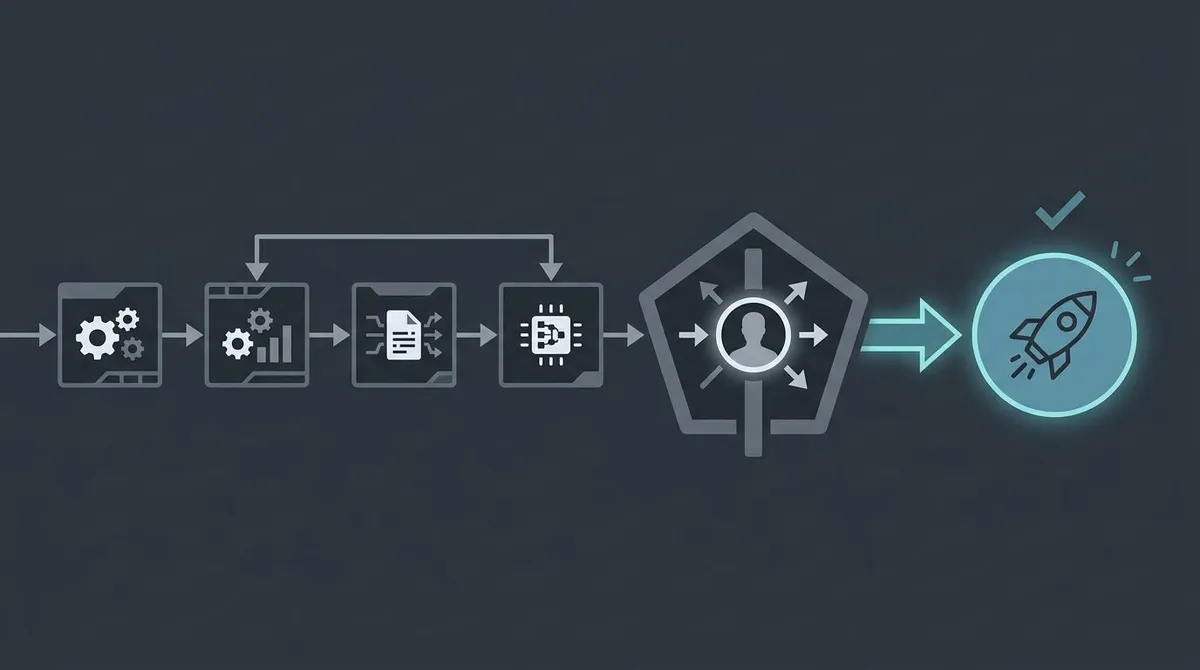
Lunroo: an automated workflow with a human approval step
That's the gap Lunroo is built for. Instead of a single autonomous bot doing everything in one pass, Lunroo runs the work as distinct stages:
- Research — keyword targets, SERP analysis, and angle.
- Drafting — the article is written in your brand voice.
- Editing — optimized for SEO and readability.
- Publishing — once approved, it ships to your CMS on schedule.
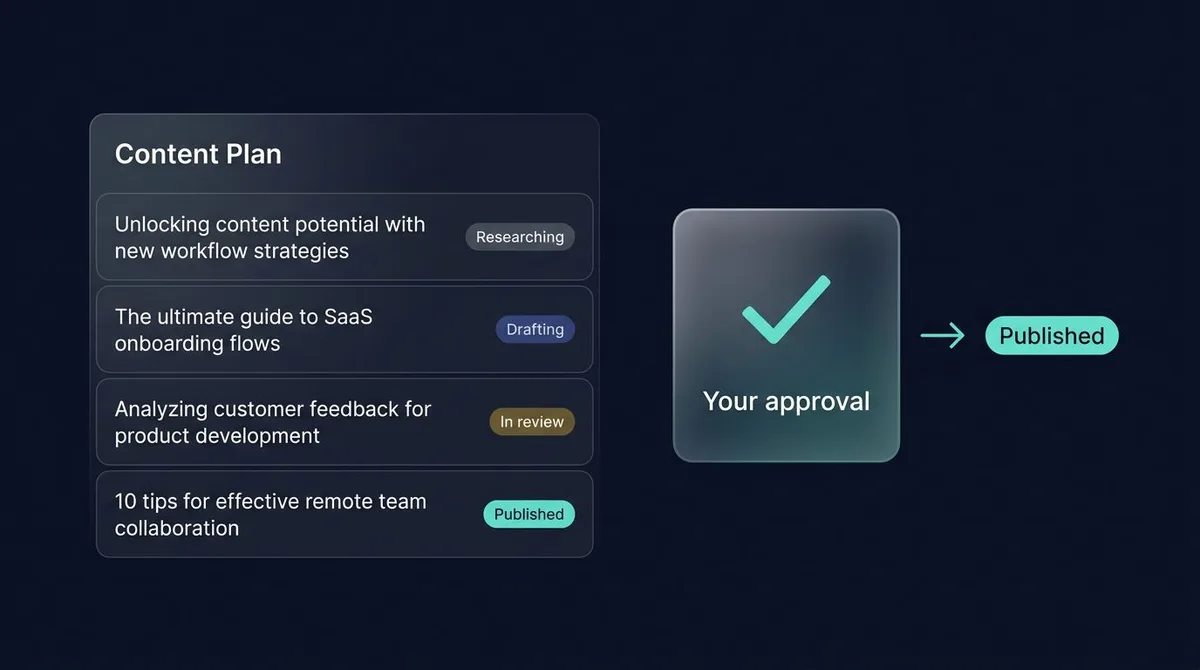
Lunroo handles the volume the same way an autonomous SEO software would. The difference is the last step: drafts land in draft mode and wait for you. Nothing publishes until you approve it. You can edit, request changes, or ship it — but the decision stays yours.
It all happens in Notion, where a lot of founders already plan. Your briefs, drafts, and approvals live in your workspace instead of a separate dashboard you have to remember to check. Review and edits happen where you already work.
The result is automation without abdication. You get a research-to-optimize pipeline running continuously that improves over time — you can read more about how AI agents automate marketing and see the full capability list on the features page. What you don't get is content going live that you never saw.
SEOBot vs Lunroo: side-by-side comparison
Here's an honest head-to-head. Both tools automate SEO content; they differ on how much you stay in the loop.
| Lunroo | SEOBot | |
|---|---|---|
| Automation model | Multi-stage workflow runs the pipeline; you approve | Fully autonomous, 100% autopilot by default |
| Human review / draft mode | Yes — draft-and-approve before anything publishes | Optional; runs zero-touch unless you take control |
| Where you work | Notion-native (plan, review, publish in your workspace) | Dedicated dashboard |
| Pipeline | Distinct research, drafting, editing and publishing stages | Single autonomous SEO agent |
| Content research + SEO | Yes — keyword research, on-page optimization, brand voice | Yes — keyword research, long-form articles, internal linking |
| Rank tracking & analytics | Yes — built-in rank tracking and insight dashboards | Focus on generation and publishing volume |
| CMS / publishing | Publish from Notion; approval-gated | Direct auto-publish to WordPress, Shopify, Webflow |
| Best-fit user | Founders who want automation with oversight | Founders who want maximum hands-off volume |
| Pricing | One subscription, no free tier — see pricing | Lower entry price — check SEOBot's site |
A couple of honest notes on the table. SEOBot's direct CMS auto-publish is a genuine convenience if you want articles live without a middle step — that's the whole point of autopilot. And on price, SEOBot's entry tier is lower; Lunroo bundles the full workflow, tool credits, LLM tokens, and analytics into a single plan, which is a different value shape. Compare both against your own numbers on the pricing page.
When SEOBot is the better choice
I'll be direct: SEOBot is the better pick for some founders. Choose it when:
- You want pure hands-off volume. If your goal is a high cadence of published articles with zero involvement, autopilot is the most efficient path.
- Budget is the top constraint. If you need the lowest possible entry price to get started, SEOBot's pricing is hard to beat.
- You want direct CMS auto-publish. If articles going straight to WordPress, Shopify, or Webflow without a review step is a feature (not a risk) for your use case, that's exactly what it's built for.
If you're publishing high-volume content on a site where perfect brand voice and pre-publish review matter less than throughput, SEOBot does that job well. Don't over-engineer it.
When Lunroo is the better fit
Lunroo makes more sense when control and coordination matter as much as volume. Reach for it when:
- You want to approve every draft. A human-in-the-loop step before publishing is non-negotiable for your brand.
- Brand voice is part of your product. You want agents writing the way you write, not generic AI copy.
- You already live in Notion. Reviewing and editing where you plan beats logging into one more tool.
- You want more than a blog bot. A coordinated content, SEO, and analytics workflow — research, drafting, optimization, and rank tracking as one loop — rather than article generation alone.
This is the same logic behind other tool decisions in this cluster — whether you're weighing an Outrank alternative, a SurferSEO alternative, or a Jasper alternative, the question is always automation versus control, and how coordinated the workflow is. For founders specifically, our take on SEO for startups and how to build a content strategy goes deeper on the workflow side.
How to switch from SEOBot to Lunroo
Switching doesn't mean losing your progress. Here's a practical path:
- Keep your published articles where they are. Existing content stays live on your CMS. There's nothing to migrate on that front.
- Bring your keyword list. Export the targets and topics you've been working, so the research stage can pick up the same roadmap instead of starting cold.
- Set your brand voice. Give Lunroo a few examples of how you write — the agents train on your voice, not a generic template.
- Run your first briefs in Notion. Plan the next batch in your workspace, let the agents draft, and review before anything ships.
- Approve and publish. Edit what you want, approve what's ready, and keep rank tracking running in the background.
One honest note on scope: Lunroo's agents cover content, SEO, and analytics today. Social media scheduling and email campaigns are on the roadmap — coming soon, not live yet — so don't switch expecting those this week.
If you'd rather have research, drafting, and optimization run on autopilot while you keep the final say, start with Lunroo. For pricing details, the pricing page is the source of truth. And if you want the fundamentals first, our guide on how to automate SEO is a good next read.
FAQ
Is there a free SEOBot alternative?
Lunroo doesn't have a free tier — it's a paid subscription with the full workflow, tool credits, LLM tokens, and analytics included in one plan. If a permanently free tool is your hard requirement, Lunroo isn't it. If you want to compare what's included against the cost, the pricing page has the current details.
Does Lunroo publish automatically or let me review first?
You review first. Drafts land in draft mode and wait for your approval — nothing publishes until you sign off. That's the core difference from a full-autopilot tool: the agents do the work, but the decision to ship stays with you.
Can I use Lunroo without Notion?
Lunroo is Notion-native by design — planning, briefs, drafts, and approvals live in your Notion workspace, which is where a lot of founders already work. If you don't use Notion at all, that workflow is a bigger adjustment, so it's worth factoring into your decision.
Is Lunroo cheaper than SEOBot?
Not on entry price. SEOBot's starting tier is lower. Lunroo bundles the full content workflow, research and SEO tools, LLM tokens, and analytics into a single subscription, so it's a different value shape rather than a straight price match. Check current numbers for both — Lunroo's are on the pricing page.
Does Lunroo do social media and email?
Not yet. Today the agents cover content creation, SEO optimization, and analytics. Social media scheduling and email campaigns are on the roadmap — coming soon, not shipping today. If those are must-haves right now, plan around that.
What's the main difference between SEOBot and Lunroo?
Automation model. SEOBot is a single autonomous bot that runs fully hands-off and can auto-publish to your CMS. Lunroo runs the same kind of pipeline as distinct research, drafting, and editing stages, but adds a human approval step and lives in Notion. Pick SEOBot for maximum zero-touch volume; pick Lunroo when you want automation with oversight.