RankPill Alternative for Founders (2026)
If you're shopping for a RankPill alternative, you're usually not unhappy with the idea of automated SEO content. You're unhappy with one specific thing: an autopilot tool publishing AI-written pages straight to your domain with no review step. That tension — hands-off volume versus editorial control — is what sends most founders looking.
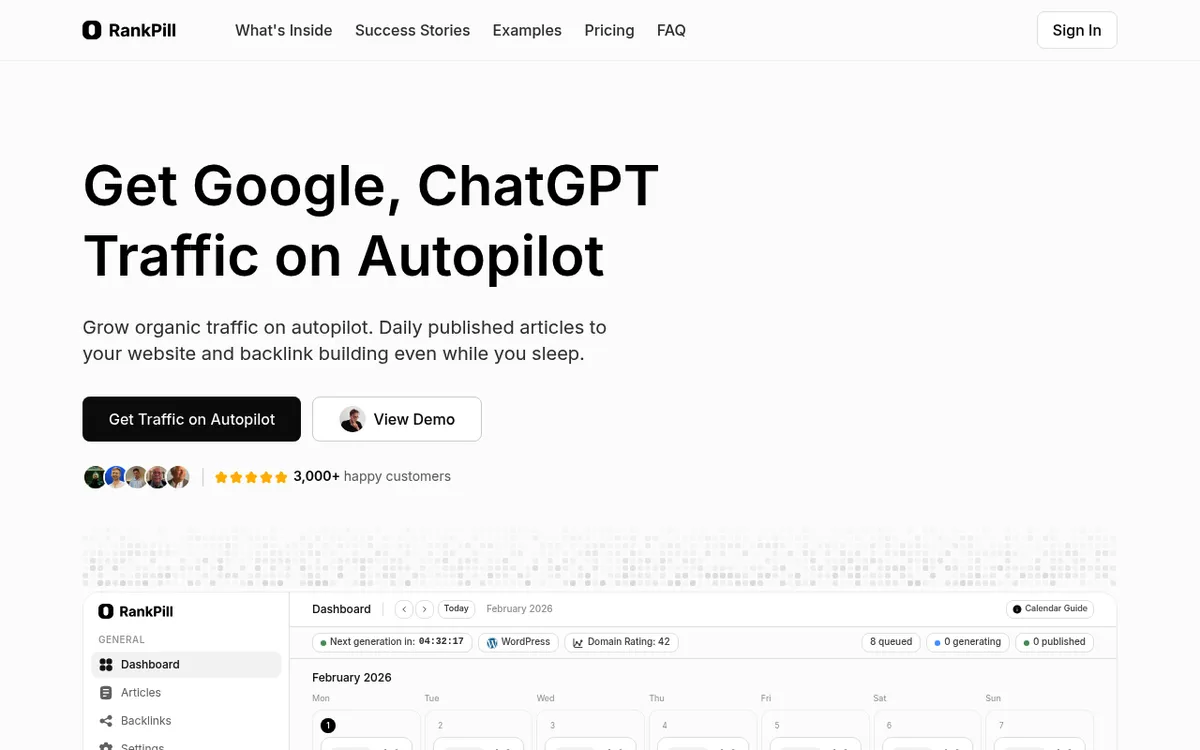
Here's the short version. RankPill is genuinely good at what it does: fast, low-effort blog content on autopilot. Lunroo takes a different shape — a multi-stage content workflow plus a draft-and-approve step, so you scale content without shipping anything you haven't seen. This post walks through the honest tradeoffs so you can pick the right one.
Why founders look for a RankPill alternative
Most founders who try automated SEO content tools land in the same spot. The volume is great. The convenience is great. Then a page goes live that says something slightly off about the product, gets a competitor's name wrong, or reads like it was written by a tool that has never used your app.
The problem isn't the AI writing. It's that the AI writing goes live before a human reads it. When your blog is a subdomain nobody notices, that's tolerable. When it's yourdomain.com/blog and it's part of how buyers judge you, "publish first, check later" starts to feel risky.
So the search for a RankPill alternative is really a search for the same automation with more control. You want the agent to do the boring 90% and you to approve the last 10%.
What RankPill does well
Let's be fair before we get to differences, because RankPill earns its users. If you want a realistic RankPill review, start with its strengths:
- True autopilot. You set up a project, pick keywords, and it produces and publishes articles on a schedule with almost no ongoing input.
- Low effort, real volume. For founders who want a steady drip of indexed pages without touching a CMS, the automated SEO content generator model works.
- Simplicity. There's not much to learn. That's a feature when you're busy building product.
If your only goal is "put more pages on the internet targeting long-tail keywords, and don't make me think about it," RankPill's hands-off model is a legitimate fit. Plenty of RankPill competitors — RankYak, RankPilot, and the rest of the price-ranked listicles — compete on that same axis of cheaper, faster autopilot.
Lunroo isn't trying to win that race. We compete on a different axis.
Where founders hit limits
The strengths above come with tradeoffs. None of these make RankPill a bad tool — they're the natural cost of a pure autopilot design.
Content publishes before you read it. The core one. Bulk autopilot means pages can go live without a human sign-off. If a claim is wrong or the tone misses, you find out after it's indexed.
Brand voice is harder to lock down. A one-shot generation pipeline tends toward a generic AI register. For a listicle that's fine; for pages that represent your product, "sounds like every other AI blog" is a cost.
The workflow is a black box. You get output, but not much visibility into the research, the editing, or why the article made the choices it made. When you want to steer, there isn't much surface to grab.
Google's own guidance on creating helpful content keeps coming back to the same idea: content should be made for people, demonstrate real experience, and be genuinely useful. Unreviewed bulk output is exactly where that gets hard to guarantee. A review step isn't red tape — it's how you keep quality high as volume goes up.
How Lunroo is different
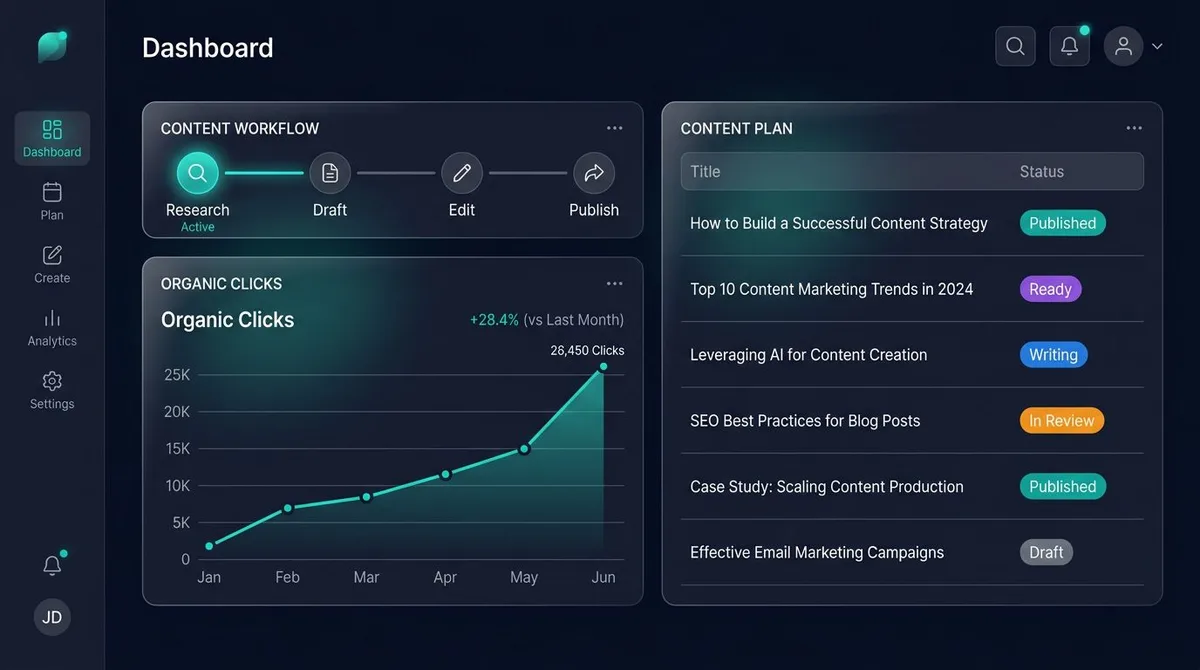
Lunroo replaces the single autopilot with a multi-stage workflow, and it adds the review step back in. Instead of one model doing everything in one pass, the work moves through four distinct stages:
- Research — keywords, SERP, angle, and what's already ranking.
- Drafting — the article is written in your brand voice, structured around the brief.
- Editing — tightening, fact-checking structure, and tuning on-page SEO.
- Publishing — once you approve, it ships to your CMS on schedule.
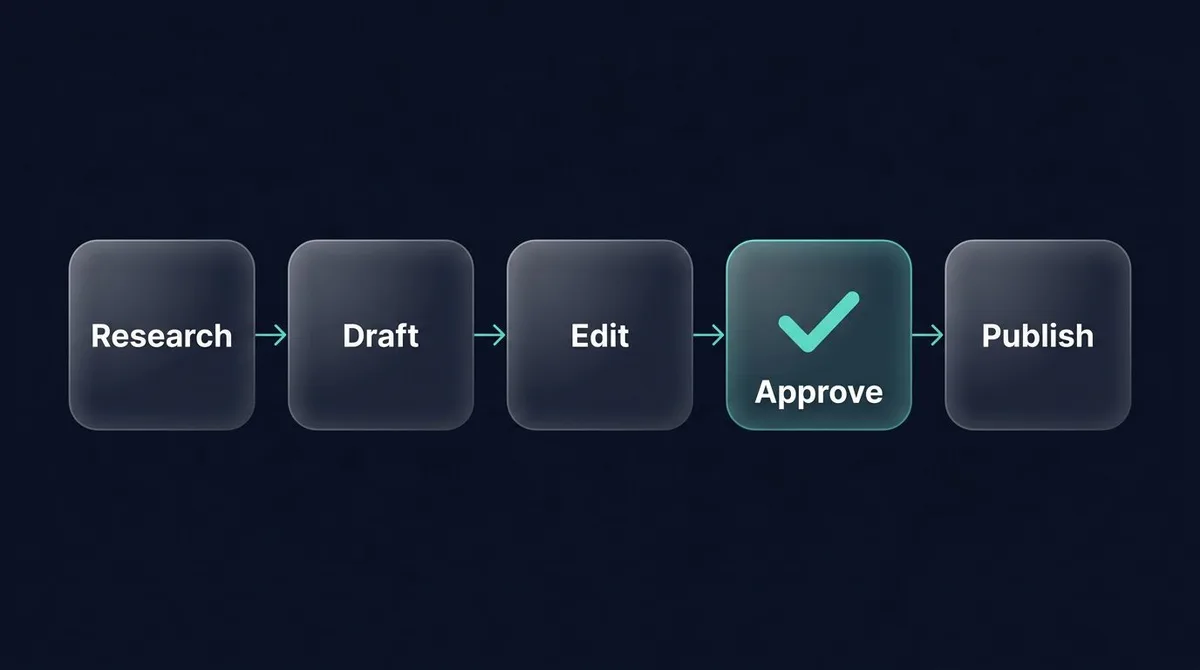
That's the "a real workflow, not a prompt box" idea in practice. Each stage has a job, work passes from one to the next, and the system improves as it learns your voice. If you want the deeper mechanics, how AI agents automate marketing breaks down how the pipeline runs.
Two things make this a real RankPill alternative rather than another autopilot clone:
Draft-and-approve. Everything lands as a draft first. You review, edit, and approve — nothing publishes to your domain without your sign-off. You get automation's volume without automation's "oh no" moments.
Notion-native. Briefs, drafts, and the content calendar live in your Notion workspace, where founders already plan. You're not logging into another dashboard to see what's happening; the work shows up where you work.
That's the whole difference in one line: RankPill optimizes for hands-off, Lunroo optimizes for hands-on-the-last-mile.
RankPill vs Lunroo: comparison table
Here's how the two line up across the things founders actually weigh. Honest read: if a row favors RankPill for your situation, trust that.
| What you're weighing | Lunroo | RankPill |
|---|---|---|
| Core model | Multi-stage workflow (research, drafting, editing, approval) | Single autopilot content engine |
| Human approval | Draft-and-approve — nothing ships unreviewed | Autopilot publishing, minimal review step |
| Where content lives | Notion-native (plan, brief, approve in Notion) | In-app dashboard + your CMS |
| Brand voice control | Trained per customer, editable at draft stage | Configurable, less mid-pipeline control |
| Research depth | Dedicated research stage before writing | Automated keyword-to-article generation |
| Scope | Content + SEO + analytics as one loop | Focused on blog content generation |
| Social & email | On the roadmap — not live yet | Focused on blog content |
| Best for | Founders who want control + quality | Founders who want pure hands-off volume |
| Pricing | One subscription, everything in — see pricing | Tiered plans; check their site |
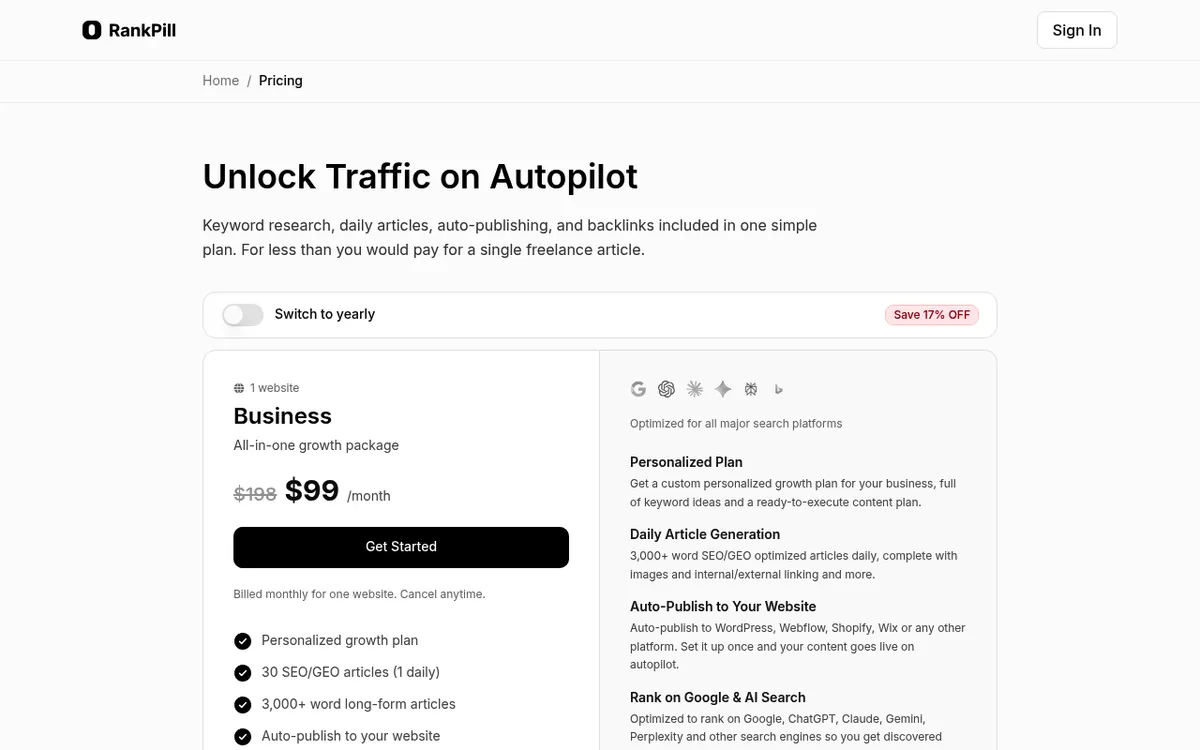
A note on that last row: we don't hardcode prices in blog posts because they change. For the current number, our pricing page is the source of truth. Worth saying plainly — there's no free tier. Lunroo is a paid subscription that replaces a stack of tools and a freelancer or two, not a free content faucet.
If you'd rather see this running than read about it, you can start with Lunroo and watch it produce your first drafts.
Who each tool is best for
The honest routing, because the wrong tool for you helps nobody:
Choose RankPill if you want maximum hands-off volume and you're comfortable with pages publishing automatically. If your priority is "more indexed long-tail pages with zero ongoing effort," its autopilot model is built for exactly that.
Choose Lunroo if the content represents your brand and you want a review step before anything goes live. If you care about voice, want research and editing as distinct stages, and want to plan in Notion, the staged-workflow model fits better.
This isn't unique to RankPill, by the way. The same control-versus-autopilot question shows up across the category — it's the through-line in our Outrank alternative, SurferSEO alternative, and Jasper alternative breakdowns too. If you're comparing bulk generators specifically, the SEObot alternative post covers that end of the spectrum.
And if you're earlier in the journey — still figuring out the engine before the tool — content marketing for startups and how to write SEO content are better starting points than any comparison table.
Pro tip: whichever you pick, keep one human review gate somewhere in the process. The founders who get burned by AI content are almost always the ones who removed the last human from the loop entirely.
FAQ
Is Lunroo a true RankPill alternative?
Yes, for the job most people hire RankPill to do — producing SEO content without a full-time writer. The difference is model and control. RankPill runs a single autopilot that publishes for you; Lunroo runs a multi-stage workflow — research, drafting, editing — and adds a draft-and-approve step so you review before anything goes live. Same outcome of "more good content, less effort," different path to get there.
Does Lunroo auto-publish content to my site?
No — not without your approval. Everything Lunroo produces lands as a draft first. You review, edit, and approve, and only then does it publish. That's the core design choice that separates Lunroo from pure autopilot tools. Note that social scheduling and email campaigns are on our roadmap and not live yet, so don't count on those today; the writing, SEO, and publishing-to-draft loop is what's shipping now.
Do I have to use Notion?
Lunroo is Notion-native, so your briefs, drafts, and content calendar live in your Notion workspace. That's a deliberate choice — founders already plan there, and it keeps the whole pipeline visible in one place. If you don't use Notion at all, it's worth trying a lightweight workspace to get the full workflow. You can see the broader setup on the features overview.
Is there a free tier?
No. Lunroo is a paid subscription with everything included — tool credits, LLM tokens, custom brand voice, and analytics. There's no permanent free plan. The way to think about the cost is one subscription instead of a copywriter plus an SEO retainer plus a stack of point tools. Current pricing lives on the pricing page.
How is a multi-stage workflow better than one AI writer?
Because the work gets split the way a real content team splits it. Research, writing, and editing are different jobs, and doing them as separate stages produces better output than a single model doing all three in one pass. One stage gathers the angle, the next drafts it, the next sharpens it, and an approval gate keeps you in control. It's the same reason human teams don't have one person research, write, and edit in a single sitting.
Can I switch from RankPill without losing my existing content?
Your published articles stay on your site — switching tools doesn't touch what's already live. What changes is how new content gets made going forward. Most founders keep their existing pages, point Lunroo at the next batch of keywords, and move to the draft-and-approve workflow from there. If you want to test it against your current setup, start with Lunroo and run a few briefs side by side.